
23 min read ·
How to Prepare for the Adjuster—and Protect a Water-Damage Claim
Insurer-assigned adjusters generally represent the carrier. Public adjusters represent the policyholder. Your records provide a second check on scope and estimate.
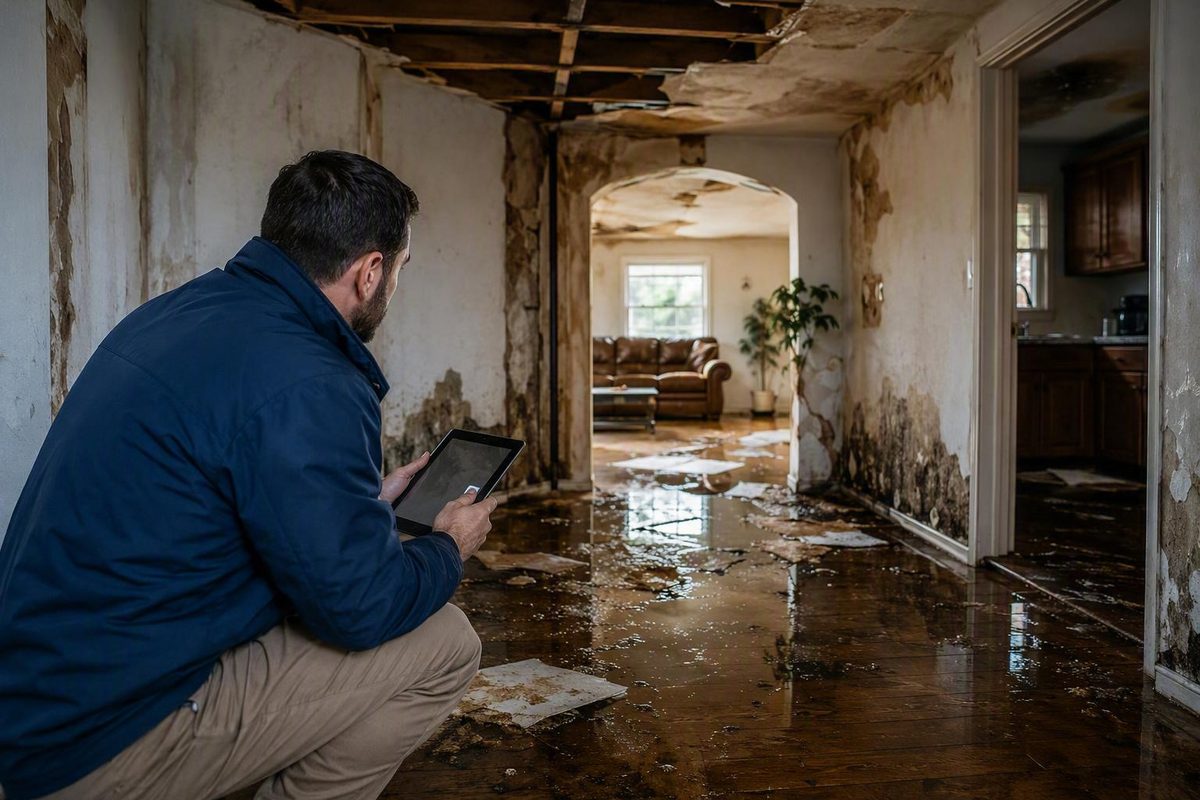
A water-damage insurance adjuster does more than look at a wet floor. The adjuster investigates what happened, documents affected property, evaluates the repair scope, and considers how the policy applies. But the inspection is not a process you must watch from the sidelines.
Your role is not to argue every detail or diagnose a cause you do not know. It is to protect people, prevent avoidable additional damage, preserve evidence, identify every affected area, and compare the eventual estimate with what actually needs to be repaired or replaced. That factual record becomes especially important when moisture has traveled beyond the most obvious stain or puddle.
The first distinction to understand is whom the adjuster represents.
Which water-damage adjuster are you dealing with?
An insurance adjuster is a claim professional who investigates a reported loss. In a water-damage claim, that work may include inspecting and photographing the property, asking when and how the damage was discovered, measuring affected areas, reviewing damaged belongings, comparing findings with policy terms, and estimating the insurer’s responsibility.
The word “independent” can cause confusion. An independent adjuster is normally an outside professional or firm hired by the insurance company. The adjuster may not be an employee of that carrier but still generally works on the carrier’s behalf. A company or staff adjuster is employed directly by the insurer.
A public adjuster has a different client. Public adjusters are licensed professionals hired by policyholders to help document, prepare, and negotiate property claims, subject to state law and the engagement contract. The basic distinction is representation: insurer-assigned adjusters generally represent the carrier, while public adjusters represent the policyholder. This distinction is also described in a public-adjusting firm’s comparison of public, company, and independent adjusters.
| Adjuster type | Whom the adjuster represents | Who assigns or hires the adjuster | Typical duties | How the adjuster is paid |
|---|---|---|---|---|
| Company or staff adjuster | Insurance company | Insurance company | Investigates the loss, inspects damage, reviews coverage, prepares or reviews an estimate, and communicates the carrier’s position | Salary or other compensation from the insurer |
| Independent adjuster | Insurance company | Insurance company or its claim administrator | Performs many of the same field and claim-evaluation functions as a staff adjuster, often as an outside vendor | Paid by the insurer or adjusting firm |
| Public adjuster | Policyholder | Policyholder | Reviews the policy, documents damage, prepares estimates or inventories, supports submissions, communicates with the insurer, and negotiates the property claim | Paid under a contract with the policyholder, often through contingency compensation |
An adjuster is also not interchangeable with every other professional who may enter the claim:
- A restoration contractor extracts water, dries materials, cleans affected areas, performs demolition, or completes repairs. A contractor can document completed work and price a construction scope, but representing a policyholder in a claim may be subject to separate state licensing rules.
- An insurance agent sells or services policies and may help with initial reporting or general policy questions. The agent is not ordinarily the person who measures and adjusts the loss.
- A public adjuster represents the policyholder in preparing and negotiating a property claim within the limits of the applicable license.
- An attorney provides legal advice and representation. Coverage litigation, legal deadlines, and allegations of improper claim handling belong in the legal sphere, not ordinary construction estimating.
One business may offer more than one service, but that does not erase the differences. Licensing and conflict-of-interest rules vary by state. Ask each participant to state what role the person is performing, whom the person represents, and who is paying for the work. Obtain that explanation in writing when the roles are unclear.
The arrival of an insurer-assigned adjuster does not prevent you from documenting the same damage. You may keep your own photographs, room measurements, inventory, chronology, contractor estimates, and expense records. Doing so is not inherently hostile; it creates a second factual record against which you can review the insurer’s scope and estimate.
What to do before the adjuster arrives
Begin with safety. Treat standing water near electrical equipment, sagging ceilings, unstable materials, and visibly contaminated water as hazards rather than ordinary cleanup conditions. Keep occupants away and use qualified utility, plumbing, electrical, emergency, or restoration help when the situation cannot be handled safely. Commercial water-loss guidance likewise emphasizes safety, source control, prompt reporting, and professional help for significant or contaminated losses, although site-specific decisions require qualified assessment (Midwestern Adjusters).
If it is safe and reasonably possible, stop or isolate the source. That may mean closing a fixture valve, shutting off the building’s water supply, turning off an appliance, or arranging an emergency plumbing repair. Then take reasonable steps to limit additional damage, such as extracting standing water, beginning appropriate drying, moving unaffected belongings away from moisture, or temporarily protecting a storm-created opening.
Do not postpone urgent hazard control solely because the adjuster has not arrived. Claim-preparation guidance generally recommends stopping the source, mitigating additional damage, documenting the conditions, and notifying the insurer promptly rather than preserving an unchanged but worsening scene. A restoration provider’s water-damage claim guidance describes the same general sequence.
Notify the insurer promptly and follow the reporting instructions in your policy. Do not assume that every policy imposes the same 24-hour or 48-hour deadline. When reporting the claim, provide the known facts:
- When you discovered the water
- Where you first observed it
- What you did to stop or limit it
- Which rooms or belongings appear affected
- Whether emergency professionals are involved
If the cause or duration is uncertain, say so. “I found water beneath the kitchen sink at 7:15 a.m.” is a useful observation. “The pipe must have been leaking for exactly two days” is speculation unless evidence supports it.
When safely practical, take photographs and video before moving belongings or removing materials. Start with wide views that establish the room and apparent water path. Then capture close-ups of stains, swelling, buckling, water lines, damaged contents, and the suspected release point. Do not delay shutting off water or controlling an urgent electrical, structural, or contamination concern merely to create a perfect photo sequence.
Emergency mitigation and permanent reconstruction should be treated differently. Extraction, drying, temporary protection, or a plumbing stop may need to happen immediately. Permanent reconstruction can often wait until the damage has been documented and the insurer has had a reasonable opportunity to inspect, but only when waiting is consistent with policy instructions, applicable deadlines, safe conditions, and the need to prevent additional damage.
If wet materials or belongings must be discarded because retaining them would be unsafe or impractical, document them first when possible. Photograph each item, record its brand or identifying features, and retain serial-number plates, labels, samples, hauling records, or disposal receipts where safe. Tell the insurer what was removed, why it was removed, and who performed the work.
First-response checklist
- Safety: Keep occupants away from electrical, structural, or contaminated-water hazards.
- Source control: Stop or isolate the water source when it is safe to do so.
- Insurer notice: Report the loss promptly under the policy’s instructions.
- Initial media: Take wide-angle and close-up photographs and video.
- Mitigation: Extract water, begin appropriate drying, and use temporary protection as conditions require.
- Receipts: Retain invoices for emergency labor, equipment, supplies, lodging, and disposal.
- Chronology: Record discovery, source-control, notification, mitigation, and inspection times.
This sequence protects people and property without treating evidence preservation as a reason to let damage continue.
Why the source and timing of the water matter
Water coverage is not determined by the appearance of the damage alone. It depends on the policy language, cause and timing of the event, exclusions, endorsements, coverage limits, sub-limits, deductible, maintenance history, evidence, and applicable law.
Homeowners policies may treat sudden and accidental internal water damage differently from gradual seepage, neglected maintenance, sewer backup, or outside flooding. “Water damage” is therefore a description of the result, not a coverage conclusion. An insurance agency’s overview identifies sudden internal releases as commonly considered differently from gradual leakage, flooding, sewage backup, and certain maintenance-related losses, while emphasizing that policy terms control (C&S Insurance).
| Cause of loss | Common coverage issue | Useful documentation |
|---|---|---|
| Burst or suddenly failed pipe | Resulting water damage may be considered for coverage, subject to exclusions and policy conditions; the failed pipe itself may be treated differently | Plumber’s findings, photographs of the break, failed section when feasible, water-shutoff time, drying records |
| Appliance failure or accidental overflow | Sudden discharge may be eligible for coverage consideration; repair or replacement of the failed appliance may be separate from resulting damage | Appliance model and serial number, service report, photographs, purchase or maintenance records |
| Storm-created opening or roof intrusion | Coverage may turn on whether a covered event created the opening, the roof’s condition, and applicable wind or rain provisions | Exterior and interior photographs, weather information, roofer’s findings, prior maintenance records |
| Gradual leakage or seepage | Long-term leakage, deterioration, or neglected maintenance may be excluded or limited | Discovery timeline, prior repairs, maintenance records, plumber’s findings, photographs of the release area |
| Sewer backup | Coverage may be excluded or limited unless an applicable endorsement or separate coverage applies | Backup source, plumber or municipal report, endorsement, cleanup and disposal records |
| External or natural flooding | Generally handled outside standard homeowners coverage and may require separate flood insurance | Flood-policy documents, photographs of water entry and levels, event details, mitigation records |
These are screening issues, not promises of coverage. A burst pipe is not automatically covered, and a roof leak or gradual condition is not automatically excluded. The actual policy, evidence, and cause investigation control.
The failed component may also be treated differently from the resulting damage. An insurer might evaluate water-damaged drywall, flooring, or cabinets separately from the corroded supply line, failed water heater, dishwasher, or worn roof component that released or admitted the water. Ask the insurer to explain both parts of its position: treatment of the failed component and treatment of the resulting damage.
External flooding is another important dividing line. Water rising from a river, overflowing surface water, storm surge, or a similar natural flood event is generally treated separately from standard homeowners coverage and may require a flood policy. Restoration-industry claim guidance likewise distinguishes natural flood damage from internal water releases and advises checking for separate flood insurance (Lightspeed Restoration). When reporting an indoor loss, describe what you observed instead of casually labeling every water event a “flood.”
Avoid guessing how long a leak existed. Build an accurate discovery timeline instead:
- When was the area last known to be dry or functioning normally?
- When did someone first see, hear, or smell evidence of water?
- What did that person observe?
- When was the source stopped?
- What did the plumber, roofer, appliance technician, or restoration firm find?
- Was there previous service or maintenance involving the same area?
Gather the professional’s written findings, photographs of the release point, relevant maintenance records, and the failed component when retaining it is feasible and safe. These materials do not guarantee coverage, but they can help separate documented observations from assumptions.
Build a claim file that shows the full loss
A strong claim file should allow someone unfamiliar with the home to understand what happened, what changed, which areas were affected, what emergency work occurred, and how the claimed costs were calculated.
Start with a room-by-room media log. For every affected room, capture:
- A wide view from each doorway or corner
- The path or apparent direction of water travel
- Water lines and stains
- Close-ups of swollen, cracked, stained, warped, or detached materials
- Flooring transitions and individual layers where exposed
- Baseboards, drywall, trim, cabinets, and built-ins
- Damaged furniture and personal property
- The suspected source or entry area
- Any lower-level room beneath an upstairs release
Add brief captions or filenames that identify the room, subject, and date. A file called IMG_4837.jpg is less useful than 2026-08-13_kitchen_sink-cabinet_swollen-base.jpg.
For damaged contents, create an itemized inventory rather than a single statement such as “bedroom furniture ruined.”
| Inventory field | What to include |
|---|---|
| Item description | Brand, model, size, material, color, and distinguishing features |
| Quantity | Number of identical or similar items |
| Age or purchase date | Exact date if available; otherwise a reasonable approximation clearly marked as such |
| Pre-loss condition | New, good, worn, repaired, or otherwise relevant |
| Location | Room, cabinet, closet, or storage area |
| Evidence | Photographs, receipts, manuals, online order history, credit-card records, or warranty information |
| Replacement evidence | Current price for a reasonably comparable item |
| Disposition | Retained, cleaned, moved, sampled, or discarded |
Do not inflate quality or invent purchase information. If you do not know an item’s exact age, mark it as an approximation and retain whatever evidence supports the estimate.
Keep mitigation invoices, drying logs, cleanup bills, temporary-repair receipts, detailed contractor estimates, plumbing or engineering reports, and disposal records. If displacement is relevant, preserve lodging, additional meal, pet-boarding, laundry, transportation, and other temporary-housing records. Whether a particular expense is covered depends on the policy and circumstances, but an undocumented expense is harder to evaluate.
Your chronology should list:
- Date and time of discovery
- Conditions observed
- Time the source was stopped
- Initial photographs or videos taken
- Insurer notification and claim number
- Emergency vendor arrivals
- Extraction, demolition, or drying milestones
- Adjuster appointments and inspections
- Newly discovered damage
- Estimates and invoices received
- Payments, reservations, denials, or settlement offers
Maintain a separate communication log for calls, emails, texts, and letters. Record the date, participants, subject, important statements, requested documents, promised follow-up, and due dates. Include adjuster reassignments and canceled or rescheduled inspections. Follow an important phone conversation with a concise email confirming your understanding.
Detailed photographs, inventories, receipts, moisture records, professional findings, and communication logs are commonly recommended in water-loss claim preparation. A public-adjusting firm’s documentation guide gives examples of these records; because the publisher sells claim services, use it as practical guidance rather than as a substitute for your policy or regulator instructions.
A practical digital folder structure might look like this:
Water-Damage-Claim/
├── 01-Policy-and-Claim-Number/
├── 02-Timeline/
├── 03-Property-Photos-and-Videos/
├── 04-Contents-Inventory/
├── 05-Mitigation-and-Drying/
├── 06-Contractor-Estimates/
├── 07-Temporary-and-Other-Expenses/
├── 08-Professional-Reports/
└── 09-Insurer-Correspondence/
Back up the file and preserve copies of everything submitted. Do not rely on the insurer, contractor, or adjuster to maintain the only version of your inventory or evidence.
Documentation does not guarantee payment. It gives the insurer—and, if necessary, another adjuster, regulator, or attorney—a clearer factual basis for evaluating cause, scope, cost, and claimed expenses.
What happens during the water-damage inspection
During the inspection, the adjuster will likely photograph the damage, take room or material measurements, ask when and how the loss was discovered, examine damaged property, and identify repair tasks for an estimate. The adjuster may also review mitigation records, contractor information, or a contents inventory.
Methods vary by claim and professional. An inspection may include moisture meters, thermal imaging, floor or wall measurements, contents lists, and estimating software. Thermal imaging can indicate temperature patterns that may justify further evaluation, while moisture readings can provide additional evidence. Neither method guarantees that every concealed condition will be found. A commercial public-adjusting article describes the use of thermal imaging, inventories, and pricing software in water-loss evaluations.
Attend the inspection if possible. Before the appointment, make a room-by-room damage map identifying:
- Visible stains, warping, swelling, cracking, or delamination
- Wet or previously wet walls and ceilings
- Flooring seams, transitions, padding, and underlayment
- Cabinet interiors, toe kicks, and built-ins
- Insulation or wall cavities that may be affected
- Windows, doors, and exterior openings near water entry
- Lower floors beneath an upstairs bathroom, laundry, or plumbing leak
- Rooms where odor, humidity, or other conditions changed after the loss
Walk the adjuster through every affected room rather than assuming the most obvious room tells the whole story. If an upstairs pipe released water, point out the ceiling, walls, fixtures, and flooring below it. If kitchen cabinets were wet, identify both visible finish damage and areas where water may have traveled beneath or behind the cabinet assembly.
Use careful language. You can say, “The flooring is raised in this area, and the mitigation technician recorded elevated moisture here.” Avoid saying, “The entire subfloor is destroyed,” unless the subfloor has been exposed or professionally evaluated.
Ask practical questions during or at the end of the inspection:
- Which rooms and materials did you inspect?
- Were moisture readings taken, and in which locations?
- Was any area inaccessible or left for a later inspection?
- Will damaged contents be handled in the same estimate or separately?
- Do you need mitigation logs, invoices, reports, or additional photographs?
- Who will prepare the estimate?
- What happens next?
- When should I expect the itemized estimate or written claim position?
Ask for written findings or an itemized estimate when available. Do not assume you have a nationwide right to every internal note, photograph, moisture record, or complete claim file.
Take your own photographs during or immediately after the visit. Note any area the adjuster did not examine, could not access, or planned to revisit. If later demolition exposes additional damage, photograph the layers and conditions before permanent repairs proceed when safely practical.
Answer questions factually and concisely. If you do not know the cause, say you do not know. If you know when you discovered the loss but not when it began, keep those facts separate.
How to read the estimate and proposed payment
An adjuster’s estimate may list labor, materials, quantities, room dimensions, removal tasks, disposal, drying, repairs, and finish work. It is a proposed scope and pricing document—not a substitute for comparing the listed work with the actual property.
Read the estimate room by room and line by line. Look for:
- A missing room or lower story
- Demolition performed but not listed
- Unlisted floor padding, underlayment, vapor barrier, or subfloor work
- Cabinets, trim, insulation, or wall finishes omitted from the scope
- Incomplete extraction, drying, monitoring, or equipment charges
- Damaged contents excluded from the contents section
- Debris handling or disposal left out
- Suspected concealed moisture that was reported but not evaluated
- Quantities that do not match measured dimensions
- Repair methods that do not match the affected material or assembly
Compare the insurer’s line items with a detailed contractor estimate. Do not focus only on the bottom-line difference. One estimate may include removal and replacement while another includes cleaning; one may measure a continuous floor while another measures only the visibly affected section. Matching comparable line items reveals why totals differ.
The deductible is the policyholder’s share of a covered loss and is applied according to the policy. Hiring a public adjuster does not make it disappear. Policy limits cap the amount available under a coverage, while sub-limits may restrict particular categories of property or expense. Exclusions can remove certain causes or types of damage from coverage. For a broader explanation, see Insurance Roster’s guide to how insurance deductibles work.
Valuation also affects the proposed payment:
- Actual cash value (ACV) generally accounts for depreciation based on considerations such as age and condition.
- Replacement cost generally pays toward repairing or replacing covered property with new property of comparable kind and quality, subject to policy terms and conditions.
Some replacement-cost claims involve an initial payment reflecting depreciation and a possible later payment after eligible repair or replacement costs are documented. Do not assume withheld depreciation is always recoverable. Ask the insurer to identify the governing policy provision and explain the applicable work, proof, timing, and replacement requirements. A restoration provider’s claim guide also distinguishes ACV from replacement-cost treatment while noting that actual payment remains subject to policy terms (SERVPRO).
Separate two kinds of disagreement:
- A coverage disagreement concerns whether the policy applies—for example, whether damage resulted from a covered sudden release or an excluded long-term condition.
- A scope or pricing disagreement concerns what repair work is needed, how much material is affected, or what reasonable work costs.
A claim can involve both. A plumber’s findings may address cause, while moisture records and a contractor’s itemized scope may address the extent and cost of repair.
What to do when damage is omitted or the estimate appears too low
Begin by requesting the itemized estimate, written explanation, and clarification of which damage or expenses were accepted, limited, or excluded. If an item was not accepted, ask whether the issue concerns cause, scope, valuation, a limit or sub-limit, an exclusion, the deductible, or missing documentation.
Compare the estimate with your:
- Photo and video log
- Room-by-room map
- Moisture readings and drying records
- Mitigation invoices
- Contents inventory
- Professional reports
- Contractor scopes
- Expense receipts
Turn the differences into specific issues. “The estimate is too low” gives the reviewer little to evaluate. A more useful supplement might identify:
- Omitted area: Laundry-room water traveled into the adjoining hall, but the hall flooring is not listed.
- Omitted task: The estimate includes drywall replacement but not removal and replacement of wet insulation.
- Quantity difference: The measured continuous flooring area is larger than the estimate quantity.
- Material difference: The estimate identifies laminate where photographs and product records show engineered wood.
- Hidden moisture: Post-inspection demolition exposed wet subfloor beneath the cabinet run.
- Documented expense: The emergency extraction invoice was submitted but does not appear in the payment calculation.
Submit the supplement as a concise, organized package. Include an issue summary, supporting photographs or records, the requested correction, and relevant contractor line items. Keep proof of when and how it was submitted.
Request reconsideration or reinspection if new evidence materially changes the documented scope. Examples include newly exposed wet insulation, damage beneath flooring, updated plumbing findings, or contractor measurements showing an omitted continuous area. Commercial claim guidance recommends using additional evidence, itemized contractor estimates, and reinspection requests when an offer does not reflect documented repair costs (Allied Public Adjusters).
Keep the discussion evidence-based. An omitted task may result from incomplete access, missing documents, a measurement difference, or a coverage interpretation. Do not assume intentional misconduct merely because you disagree with the estimate.
If the disagreement remains unresolved, review the policy and contact your state insurance department for jurisdiction-specific information about complaints, licensing, claim-handling rules, and available dispute procedures. Availability depends on the policy, claim status, deadlines, jurisdiction, and applicable law.
For a substantial or complex dispute, you may consider consulting a licensed public adjuster or qualified attorney. A public adjuster may help with property documentation and negotiation; an attorney can advise on legal rights and coverage disputes. Neither can guarantee that the insurer will reverse its position, pay more, or resolve the claim faster.
When a public adjuster may—and may not—be worth the fee
A public adjuster may be worth considering when the work and amount at stake justify paid claim representation. Situations that may support a consultation include:
- Extensive damage across multiple rooms or building systems
- Suspected concealed damage that is difficult to scope
- A large or complicated contents inventory
- Competing causes or multiple potentially applicable policies
- A substantial difference between insurer and contractor estimates
- A denial involving a significant coverage question
- A persistent dispute over quantities, materials, or repair methods
- A claim the policyholder cannot realistically organize or manage
Possible services include policy review, damage documentation, contents inventory preparation, repair estimating, claim-submission support, insurer communication, and negotiation. The contract should state which services are included. Public-adjusting firms describe these services and acknowledge that small, straightforward claims may not need paid representation, but their guidance is commercial and does not establish that hiring one will improve a particular outcome.
A small, straightforward claim may not justify the expense. If the cause is clear, the insurer is responsive, all affected areas are included, and the estimate adequately addresses the repairs, the policyholder may gain little from paying a representative.
Public-adjuster compensation is often contingency-based, meaning the fee is tied to insurance proceeds. There is no reliable nationwide fee range or uniform cap supported here. Fees, calculation methods, maximums, payment triggers, and cancellation rights vary by state and contract.
A neutral break-even illustration
Suppose an insurer has proposed a gross covered payment of $40,000, and a public adjuster’s contract charges 10% of the entire eventual payment. If the gross payment increases to $45,000, the contractual fee would be $4,500, leaving $40,500 before considering the deductible or other obligations.
In that simplified example:
- Gross increase: $5,000
- Public-adjuster fee: $4,500
- Difference after the fee: $500
If the fee applied only to the additional amount, the result would be different. Ask what the percentage applies to: the entire settlement, all payments after hiring, or only an additional recovery. Also ask whether a fee is owed if the insurer does not increase its offer. The Texas regulator, for example, warns that a fee may be based on the total settlement and might remain payable without an increased offer, depending on the contract; those are Texas-specific points, not nationwide rules.
The illustration is not a prediction and does not account for taxes, repair contracts, valuation conditions, deductibles, or policy limits. Its purpose is to distinguish a larger gross settlement from a larger net recovery.
Before signing, check:
- Active state license
- Relevant water-loss experience
- Complaint and disciplinary history
- Exact scope of services
- Whether contents work is included
- Fee percentage or fixed amount
- Base against which the fee is calculated
- Payment trigger
- Treatment of prior payments
- Cancellation and termination rights
- Communication and reporting expectations
- Authority to communicate or settle
- Responsibility for experts or consultants
- Potential conflicts involving mitigation, restoration, or construction work
Texas example—not a nationwide rule: Public adjusters in Texas are licensed by the Texas Department of Insurance. Texas permits a public adjuster to charge up to 10% of the insurer’s total claim payment, and the fee may be calculated from the full settlement rather than only the disputed increase. A public adjuster working on a Texas claim also cannot serve as the contractor on that claim. The regulator advises consumers to verify licensing, complaints, disciplinary history, fees, services, and contract terms before hiring (Texas Department of Insurance).
Hiring a public adjuster does not guarantee coverage, a larger gross payment, a larger net recovery, or faster resolution. It also does not eliminate the deductible. The practical question is whether the expected value of the services—documentation, estimating, organization, communication, and negotiation—is likely to exceed the full contractual cost and added complexity.
Frequently asked questions
Should I wait for the insurance adjuster before removing water or starting emergency drying?
No. Do not delay reasonable emergency mitigation solely to preserve an unchanged scene. Protect occupants, stop the source when safe, obtain qualified help for hazardous conditions, extract standing water, begin appropriate drying, and use temporary measures needed to limit additional damage.
Photograph or record the conditions before alteration whenever that can be done safely without delaying urgent action. Keep mitigation invoices, equipment logs, receipts, and photographs showing what was removed. Permanent reconstruction can often wait for an inspection opportunity, but only when waiting is safe and consistent with policy instructions, deadlines, and the duty to prevent additional damage.
Can a water-damage insurance adjuster find moisture hidden behind walls or under floors?
Possibly. An adjuster or another qualified professional may use visual inspection, moisture meters, thermal imaging, material testing, and information from mitigation contractors. These methods can identify areas that need further evaluation, but no single tool guarantees that every concealed condition will be found.
Point out suspected locations, including wall cavities, flooring layers, cabinets, insulation, and lower floors beneath the release. Ask which areas were tested and document inaccessible areas. If later demolition exposes additional damage, photograph it promptly and notify the insurer before permanent repair when practical.
Does a public adjuster work for me or for my insurance company?
A public adjuster is hired to represent the policyholder. A company adjuster or independent adjuster assigned by the insurer generally represents the insurance company.
Representation does not guarantee a particular result. Review the public-adjuster contract to confirm the services, fee, authority, communication duties, and termination terms. Verify the person’s license with the applicable state regulator.
What should I do if hidden water damage appears after the first inspection or payment?
Photograph and video the newly exposed condition before repair when safely practical. Record when and how it was discovered, preserve removed material or samples when feasible, and obtain moisture readings, contractor findings, or other professional documentation.
Notify the insurer promptly and request instructions, reconsideration, or reinspection. Submit a supplement identifying the new area, repair task, quantity, or expense and explaining why it was not visible during the original inspection. Whether a claim can be supplemented or reopened depends on the policy, claim status, deadlines, and applicable law.
How much does a public adjuster charge for a water-damage claim?
There is no single nationwide fee. A public adjuster may charge contingency compensation based on insurance proceeds, but the percentage, fee cap, calculation base, payment trigger, and cancellation rights vary by state and contract.
Ask whether the fee applies to the entire settlement or only an additional amount, whether earlier payments are included, and whether a fee remains due if the insurer does not increase its offer. Compare the expected gross recovery with the likely net recovery after the fee, and verify the proposed terms and license with your state insurance department before signing.
The practical sequence is straightforward: make the property safe, document what changed, preserve a complete claim file, attend the inspection, compare the itemized estimate with the actual repair scope, and raise discrepancies with specific evidence. If the amount at stake and complexity justify outside help, compare the public adjuster’s full contractual fee with the likely net benefit and verify state licensing and rules before signing.
Coverage and claim procedures ultimately turn on the policy, facts, and jurisdiction. Insurance Roster provides general insurance education, not water-damage inspection, restoration, claim negotiation, individualized coverage advice, or legal representation.