
20 min read ·
How to Read Roof Marks Without Mistaking Every Pockmark for Hail
The central question is whether the combined evidence better supports an outside-in impact, an inside-out blister, or an indeterminate weathered condition.
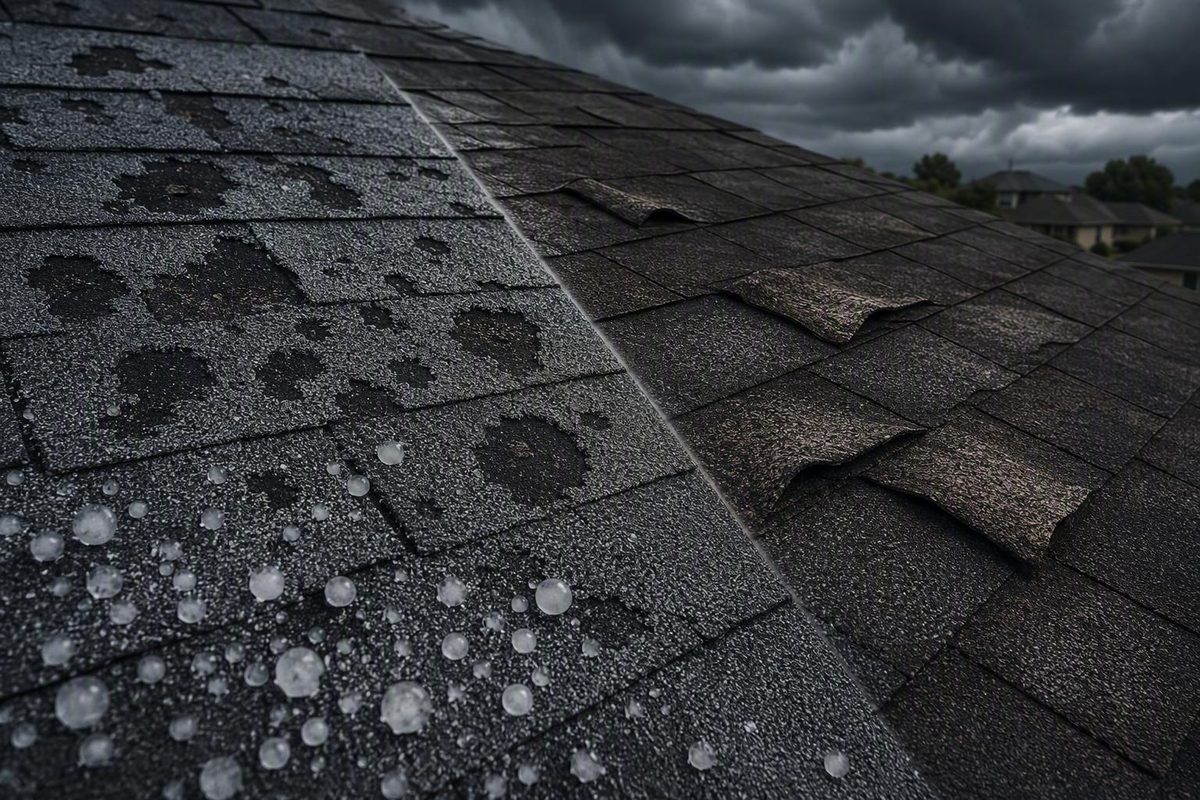
When comparing hail damage vs blistering, the safest conclusion rarely comes from one dark spot, bare patch, or fingertip test. On asphalt shingles, hail is an outside-in impact. A blister develops within the shingle, creating a raised area that may later open or erode.
The useful distinction comes from combining the mark’s profile, granule condition, texture, distribution, storm timing, collateral impacts, and the roof’s prior condition. Even then, these features are tendencies rather than proof. A weathered popped blister can closely resemble an older hail mark, and the same roof can contain both pre-existing blistering and new storm damage.
The short answer: outside-in impact versus inside-out blister formation
Hail strikes a shingle from outside. Depending on the force of impact and the roof’s condition, it may compress, bruise, crack, or fracture the asphalt coating or reinforcement mat. The resulting mark often trends toward a shallow, irregular depression.
Blistering starts within an asphalt or composition shingle. Gases, moisture, heat, material conditions, ventilation, installation, or a combination of factors can raise part of the surface. InterNACHI describes volatile gases migrating through asphalt and forming bubbles whose caps may eventually erode away (asphalt-shingle inspection guidance).
This comparison applies specifically to asphalt or composition shingles. Hail can split wood shakes, dent metal, or crack tile, so asphalt-shingle clues should not be transferred directly to other materials. Travelers, for example, distinguishes the random dark or bruised marks possible on asphalt shingles from the splits and impact marks associated with wood shingles (roof hail-damage guidance by material).
Three terms are important:
- Intact blister: A firm, raised dome or bubble that retains its cap.
- Popped blister: A blister whose cap has opened or eroded, leaving a defined pit that may expose asphalt or reinforcement mat.
- Hail impact: An external strike that may leave a depression, bruise, displaced or crushed granules, cracking, or mat fracture.
A popped blister is not simply another name for a hail crater. It began as a raised condition. Once its cap disappears and the area weathers, however, that origin may no longer be visually obvious.
| Clue | Hail impact tendency | Blistering tendency |
|---|---|---|
| Origin | External impact | Condition developing within the shingle or roof system |
| Surface direction | Usually pushed inward | Initially pushed outward |
| Typical profile | Shallow, concave, irregular depression | Raised dome when intact; defined, often steep-sided pit after opening |
| Granule condition | Granules may be displaced, crushed, loosened, retained, or embedded | Cap may retain granules until it opens; opened center may lose them |
| Texture | May show compression, bruising, cracking, or fracture | Intact dome is often firm; opened pit may have rigid edges |
| Distribution | Often variable, random, or directional | Often clustered, repeated, or widespread without storm direction |
| Timing | Potentially tied to a particular storm | Usually develops as an ongoing material or roof-system condition |
| Collateral evidence | May coincide with fresh impacts on exposed property | Usually lacks corresponding storm impacts |
| Likely next step | Document storm chronology and inspect for functional damage | Document extent and evaluate material and roof-system conditions |
These criteria come largely from industry inspection guidance, not from a validated visual test with a known diagnostic accuracy. No row in the table should be treated as a decision rule. The central question is whether the combined evidence better supports an outside-in impact, an inside-out blister, or an indeterminate weathered condition.
Four appearances to compare: intact, popped, weathered, and impacted
The phrase “roof pockmark” can describe several different stages or conditions. Separating four appearances helps prevent an intact bubble, an opened defect, and an impact bruise from being treated as interchangeable.
1. An intact blister
An intact blister typically appears as a small dome or bubble rising above the shingle. Its sides may be relatively steep, and the bump may be firm. Because its cap is still present, it can retain normal mineral granules and look less dramatic than a bare pit.
Direction is the key clue: an intact blister projects outward. Hail generally does not create a raised, self-contained bubble through impact alone.
2. A newly popped blister
Once a blister opens, it may leave a small, sharply defined pit. Typical clues include:
- Relatively steep or rigid sidewalls
- A comparatively flat or uniform bottom
- Center-focused granule loss
- Exposed asphalt binder or fiberglass reinforcement
- A slightly raised perimeter left by the original bubble
Inspection guidance contrasts these typical blister pits with hail marks by describing blisters as more steep-sided and often flat-bottomed, while hail impacts tend to have sloped, uneven bottoms. These are typical appearances, not universal findings (blister-versus-hail inspection reference).
3. A weathered blister pit
Time complicates the comparison. A pit that began with steep walls and a uniform base may eventually become less defined.
An old popped blister may therefore resemble an older hail mark. Appearance alone usually cannot reconstruct the date or cause once weathering has altered the original profile.
4. A hail impact
A typical hail mark is more likely to be a shallow, concave, irregular depression or bruise. Its granules may be:
- Displaced from the impact area
- Crushed in place
- Driven into softened asphalt
- Loosened around the edge
- Retained within the depression
A forceful impact may crack the asphalt coating or fracture the reinforcement mat. But a hail strike does not have to leave a clean, bare black circle. Granules can remain, particularly when an impact presses them into warm asphalt.
Exposed mat is not exclusive to either condition. An opened blister may expose it, but a damaging impact may fracture or expose it too. The same caution applies to exposed asphalt, dark coloration, and granule loss: each can result from more than one process.
Illustration brief: Show labeled cross-sections and top views of an intact raised blister, a newly popped steep-sided blister pit, a weathered blister with softened edges, and a shallow irregular hail bruise with displaced or embedded granules. Mark every example “typical, not diagnostic,” and show that exposed asphalt or mat can appear in more than one condition.
Use a multi-clue assessment, not a one-mark test
A reliable assessment works like a case file, not a spot quiz. Start with the physical mark, then compare its location and pattern with storm timing, collateral property damage, and the roof’s documented history.
Stronger combinations favoring hail
The evidence leans more strongly toward hail when several of these conditions appear together:
- Shallow or irregular depressions of varying sizes
- Crushed, displaced, loosened, or embedded granules
- Bruising, cracks, punctures, or mat fracture
- A scattered or directional pattern
- Heavier evidence on storm-facing elevations
- Corresponding fresh marks on exposed metal, siding, screens, windows, or outdoor property
- A documented storm followed by newly observed roof conditions
This combination is more persuasive than simply finding a black spot after a hailstorm. Chronology connects the condition to an event, while profile, fracture, and collateral evidence support an impact mechanism.
Stronger combinations favoring blistering
The evidence leans more strongly toward blistering when the roof shows:
- Intact raised domes
- Multiple small, sharply defined pits
- Steep or rigid pit walls
- Comparatively uniform or flat pit bottoms
- Repeated clusters or widespread non-directional marks
- Similar conditions on slopes without a clear relationship to storm exposure
- No reliable point at which the marks first appeared
This combination suggests a condition developing within the shingles rather than a series of external strikes. It does not identify one universal underlying cause. Material composition, moisture, heat, ventilation, installation, and other roof conditions may overlap.
Supporting clues that need context
Distribution is useful but not absolute. Hail often creates scattered marks of varying size, yet wind direction, roof pitch, barriers, and shielding can concentrate impacts on one elevation. Blisters may cluster in one area, while broader material or roof-system conditions can produce them across several slopes.
Collateral evidence also requires careful interpretation. Fresh dents on gutters, downspouts, vents, flashing, HVAC fins, siding, screens, or outdoor items can corroborate hail exposure. They do not prove that every nearby shingle mark came from hail because different materials respond differently to the same storm.
The absence of collateral marks does not rule hail out. Exposed surfaces may have been shielded, may face another direction, or may respond differently to impact.
Inconclusive signs when isolated
None of the following establishes hail damage or blistering by itself:
- A dark or black spot
- Missing granules
- Exposed asphalt
- Exposed reinforcement mat
- Granules near a downspout
- One area that appears soft
- One circular mark
- One bare patch
- A homeowner’s fingertip impression
After reviewing the available evidence, place the findings into one of three honest categories:
- Evidence favors hail: Several impact-related clues align with a documented storm and collateral exposure.
- Evidence favors blistering: Raised or characteristic opened blisters occur in a pattern and chronology more consistent with an ongoing shingle condition.
- Cause remains inconclusive: Weathering, mixed conditions, limited access, or conflicting clues require qualified inspection.
“Inconclusive” is a useful result. It is more accurate—and more helpful in a potential claim—than forcing a label from insufficient evidence.
Why hail marks vary from one roof or slope to another
There is no universal hail dent. Two neighboring roofs can react differently, and two slopes on the same house may show very different evidence.
Relevant variables include:
- Wind direction and speed
- Hailstone size, shape, hardness, and density
- Impact angle
- Roof pitch and orientation
- Trees, nearby buildings, and other barriers
- Shingle age and prior condition
- Surface temperature
- Deck and substrate support
- Overlays, cap shingles, edges, and cutouts
Travelers identifies wind, stone characteristics, roofing material, roof age and condition, pitch, and nearby barriers as factors affecting the location and severity of hail damage.
Direct strikes versus glancing blows
An impact arriving more squarely against the roof can transfer force differently from a glancing blow. InterNACHI’s inspection guidance describes direct impacts as potentially more damaging than oblique impacts.
Roof pitch changes that relationship. A wind-driven storm may produce more direct contact on one slope and more glancing contact on another. The storm-facing elevation can therefore show heavier evidence while a protected or differently oriented slope appears relatively unaffected.
Temperature changes the response—not the definition
Cold shingles may be more brittle and less able to absorb impact without cracking. Warmer asphalt may deform more readily, allowing an impact to press granules inward rather than eject them.
Neither observation should become a universal rule. A bare mark is not automatically a cold-weather hail strike, and retained granules do not mean a roof escaped hail. Temperature is one variable among many.
Support beneath the impact matters
Shingles do not have identical support everywhere. Conditions may differ at:
- Tab edges and cutouts
- Ridges and hips
- Cap shingles
- Areas installed over older roofing
- Locations bridging uneven substrate or voids
Edges, cutouts, overlays, caps, and areas with uneven underlying support may respond differently because the material beneath them does not provide the same resistance (impact angle and substrate-support guidance).
This also explains why sources may appear to disagree about whether edges or shingle fields are more vulnerable. Either observation may apply under particular support conditions. The relationship between the mark and the substrate matters more than a universal “hail always damages this location” rule.
Why hailstone diameter is not enough
Stone diameter alone cannot determine whether functional damage occurred. Density, hardness, wind, angle, temperature, roof condition, and support all influence the result. Fixed size thresholds therefore oversimplify the diagnosis.
The same is true of dent diameter.
Timing, roof history, and mixed damage
Hail is a discrete event. Blistering generally develops as an ongoing material or roof-system condition. That difference can help establish cause, but only when reliable evidence shows what the roof looked like before and after the storm.
A photograph taken after a storm establishes that a mark existed when photographed. It does not necessarily prove the storm created it.
Useful chronology records include:
- Pre-storm roof photographs
- Home-purchase or prior inspection reports
- Roof installation date and product information
- Maintenance and repair invoices
- Earlier contractor photographs
- Warranty records
- Dated aerial or exterior images, where sufficiently detailed
- Storm reports for the property area
- Notes showing when the condition was first observed
Document mixed conditions separately
A blistered roof can later be struck by hail. The correct assessment may therefore be “both,” rather than one or the other.
For example, one slope might contain older clusters of small, steep-sided pits together with newer shallow bruises of varying size. A report should map and describe both sets of observations instead of labeling every mark as hail or dismissing the entire roof as pre-existing blistering.
Use neutral descriptions before assigning a probable cause:
- “Firm raised dome”
- “Defined steep-sided pit”
- “Weathered pit with softened perimeter”
- “Shallow depression with displaced granules”
- “Irregular dark area; no visible fracture”
- “Crack extending through the asphalt coating”
- “Dented metal vent on west elevation”
Neutral wording preserves the observation even if professionals later disagree about causation.
Make a simple slope map
Draw the house footprint and label each roof elevation by direction: north, south, east, and west. Then record:
- Where each mark type appears
- Whether marks are raised, opened, or depressed
- Whether they occur in clusters or scattered areas
- Visible cracks or punctures
- Dents or marks on nearby components
- Trees, walls, or buildings that may have shielded a slope
- Interior moisture signs beneath the area
Take a wide photograph of each elevation before close-ups. Name files consistently—for example, west-slope-wide, west-slope-shallow-depression-01, and west-gutter-dents.
Pre-existing blistering or deterioration may affect an insurer’s causation and payment analysis. It does not automatically decide whether a later storm caused separate new damage. Distinct documentation allows the conditions to be considered separately.
Safe post-storm inspection and documentation checklist
Do not begin by climbing onto the roof. Wet, steep, brittle, or damaged roofing may be unsafe, and walking on fragile shingles may disturb granules or create additional damage. Ground-level observation and professional inspection are safer starting points when roof condition or access is uncertain (homeowner roof-inspection guidance).
Use binoculars or camera zoom where practical.
Exterior checklist
- Photograph the entire property first. Capture wide views of every accessible elevation before focusing on individual marks.
- Preserve original image files. Keep original timestamps and metadata rather than relying only on screenshots, compressed messages, or edited copies.
- Photograph exposed components. Include gutters, downspouts, vents, flashing, trim, siding, screens, windows, doors, fences, and outdoor items.
- Record directional differences. Note whether one elevation shows heavier evidence than the others.
- Look near downspouts for granules. Photograph accumulations, but do not treat them as proof of hail. Aging, runoff, foot traffic, and other roof conditions can release granules.
- Do not press, scrape, lift, cut, chalk, pry, or otherwise alter shingles. Roof walking and physical testing can disturb fragile material and complicate the evidence; inspection guidance cautions against creating additional foot-traffic damage (shingle blistering and hail inspection precautions).
- Preserve removed material when practical. If necessary temporary work removes a component, photograph its original location and condition first when it is safe to do so.
Interior checklist
From a safely accessible interior location, look for:
- New water stains
- Damp insulation
- Active dripping
- Moisture around roof penetrations
- Daylight visible through an opening
- Newly damp surfaces or musty odors
Do not assume that the absence of an immediate leak means the roof is undamaged. Hail-related moisture evidence may appear later, and AAA recommends beginning from the ground because climbing onto a damaged roof can be dangerous (homeowner hail and roof guidance).
Do not enter an attic or interior area that is not safely accessible. If there is active leaking, visible structural movement, or another immediate hazard, keep clear and seek qualified help.
Event and claim documentation checklist
Record:
- Storm date and approximate time
- When roof marks or moisture were first noticed
- Available weather reports
- Observed wind or storm direction
- Photographs and videos from each elevation
- Names and contact details of inspectors or contractors
- Written inspection findings
- Temporary work performed
- Receipts for emergency protection or drying
- Pre-storm photographs and roof records
If temporary work is necessary to prevent additional damage, photograph the existing condition first when that can be done safely. Then take reasonable protective steps and retain records and receipts. Do not delay necessary emergency action merely to produce perfect photographs.
Urgency and the roles of inspectors, roofers, adjusters, and specialists
Five questions are often collapsed into one:
- What does the mark look like?
- What probably caused it?
- Has the shingle’s water-shedding function been impaired?
- What repair scope is appropriate?
- Does the insurance policy cover that scope?
These questions require different evidence and may be answered by different people.
Appearance is not the same as function
A visually obvious mark may be superficial, while a subtle crack or mat fracture may create a greater water-shedding concern. Cracks, punctures, open fractures, and bruised or fractured reinforcement generally deserve quicker evaluation than an intact blister.
An intact blister may not create an immediate opening through the shingle. Once it opens or erodes, however, underlying asphalt or reinforcement may become more exposed to deterioration. That does not mean every opened blister leaks or every blistered roof requires replacement.
Active leaking, punctures, missing roof sections, visibly open cracks, sagging, or other potentially unstable conditions warrant prompt professional attention.
Who does what?
A roofer can inspect the roof, document conditions, assess practical repair options, and propose a scope of work. Because a roofer may also sell the work, request detailed photographs and written observations rather than relying only on the label “storm damage.”
A roof inspector or consultant can record observed conditions and may offer a causation opinion within that person’s qualifications. Ask what evidence and inspection methods support the conclusion.
An insurance adjuster investigates a reported claim for the insurer and contributes to the insurer’s application of the policy. A contractor, inspector, engineer, or educational article does not make the final coverage decision. Commercial inspection guidance likewise notes that the final claim decision rests with the insurer and its designated adjuster.
An engineer or specialized roofing consultant may be appropriate when causation is materially disputed, old and new conditions overlap, the roof assembly is unusual, or findings from interested parties conflict. An independent opinion may clarify the evidence, but it does not guarantee claim approval.
Contractor, insurer, and inspection-provider sources may have commercial or institutional interests. The most durable record is a set of dated photographs, a slope map, specific written observations, and an explanation of how each conclusion was reached.
Insurance implications: common treatment, not a coverage promise
Standard homeowners policies commonly include sudden hail as a covered peril, but that is only a starting point. Coverage and payment depend on the policy, deductible, exclusions, limits, roof condition, cause of loss, reporting requirements, and applicable law. Progressive notes that hail is typically covered under standard homeowners policies while emphasizing that payment remains subject to policy limits and deductibles (hail coverage overview).
Why blistering may be treated differently
Blistering attributed to a material defect, installation issue, ventilation condition, wear, or deterioration is often analyzed differently from direct physical damage caused by a sudden hailstorm. That does not create a universal exclusion. Policy language, causation findings, resulting damage, warranty rights, and claim facts all matter.
An older blistered roof can still sustain a later hail loss. An insurer may distinguish among:
- Pre-existing blistering or deterioration
- New hail impacts
- Work needed solely because of the older condition
- Work needed because of covered new damage
- Overlapping areas where causation remains disputed
Separate mapping and neutral descriptions help keep those issues from being collapsed into one undifferentiated condition.
Cosmetic versus functional damage
Some policies may treat cosmetic-only changes differently from damage that impairs the roof’s ability to shed water. Roof age, pre-storm condition, policy wording, deductibles, reporting deadlines, and exclusions can also affect the result.
Do not assume that “visible” means covered or that “no current leak” means undamaged. Physical condition and insurance coverage are separate questions.
Wind or hail deductibles
A policy may use:
- The same flat deductible that applies to other covered property losses
- A separate flat wind or hail deductible
- A percentage deductible calculated under the contract
A percentage deductible may be based on the dwelling coverage amount rather than the repair invoice, depending on the policy. Progressive gives an example of a separate hail deductible calculated as a percentage of dwelling coverage, illustrating why the declarations and endorsements must be reviewed rather than relying on a general summary.
For a broader explanation of how deductibles shift part of a covered loss to the policyholder, see Insurance Roster’s guide to how insurance deductibles work.
Actual cash value versus replacement cost
Valuation terms can change the timing and amount of payment even when a loss is covered:
- Actual cash value (ACV) generally accounts for depreciation.
- Replacement cost coverage generally values replacement with new property of like kind and quality, subject to policy terms and settlement conditions.
AAA explains that roof age and pre-storm condition may affect payment, that ACV accounts for depreciation, and that replacement-cost coverage generally applies a new-property valuation approach. Its guidance also recommends documenting damage, making necessary temporary repairs, retaining receipts, and contacting the insurer promptly.
No reliable claim estimate can be made from the words “hail damage” alone.
A practical claim sequence
- Review the declarations and endorsements. Look for deductibles, wind or hail provisions, roof settlement terms, cosmetic-damage language, exclusions, and reporting requirements.
- Preserve the evidence. Keep original photographs, videos, storm information, pre-storm records, and the slope map.
- Contact the insurer or agent promptly when damage is suspected. Ask how to report the loss and what documentation is requested.
- Prevent additional damage when reasonably possible. Document the condition first when safe, keep temporary work limited to what is necessary, and retain receipts.
- Cooperate with inspection. Provide relevant records and arrange safe access.
- Request written findings. Ask for the observed cause, covered damage, proposed scope, valuation method, deductible, depreciation, and policy provisions applied.
- Keep competing conditions separate. Make sure older blistering and claimed new impacts are not described as one condition.
- Seek clarification when findings conflict. Review the policy’s dispute procedures and any options available in the applicable jurisdiction.
Consistent with Insurance Roster’s educational mission, this article provides general information—not insurance, legal, roofing, engineering, or financial advice. Coverage, claims, and deductible terms vary by policy and jurisdiction, so verify the contract and applicable rules before making a claim decision (educational-content terms).
Frequently asked questions
Can popped shingle blisters look exactly like hail damage?
They can look extremely similar, especially after a blister cap has eroded and the pit has weathered. A fresh popped blister may retain a more defined, steep-sided, or flat-bottomed profile, while hail often trends toward a shallow, uneven depression. Over time, those distinctions can fade.
Do not decide from profile alone. Compare the pit with intact blisters, other marks, storm-facing distribution, visible fracture, collateral impacts, and pre-storm records.
Can hail damage retain granules instead of leaving a bare black spot?
Yes. A hail impact may displace or crush granules without removing all of them, and it may press granules into warmer asphalt. A bare black spot is not required for hail, and retained granules do not rule it out.
Conversely, a bare area does not prove hail. Popped blisters, wear, mechanical damage, and other conditions can expose dark asphalt.
Can a roof have both blistering and hail damage at the same time?
Yes. Blistering may predate a later storm, and hail can strike shingles that already contain intact or opened blisters.
Map raised domes, older defined pits, shallow depressions, cracks, and collateral evidence separately. Pre-existing blistering may affect causation and payment analysis, but it does not automatically establish that no new hail damage occurred.
Do dents in gutters or vents prove the shingles were damaged by hail?
No. Fresh dents can support the conclusion that hail reached the property, particularly when they align with storm-facing surfaces. But metal, asphalt shingles, siding, and screens respond differently to the same impacts.
Collateral dents corroborate hail exposure; they do not prove the cause or functional significance of every roof mark. Their absence does not conclusively rule hail out.
Should I file a homeowners claim before getting the roof inspected?
There is no universal sequence for every policy or situation. If there is active leaking or an urgent opening, protect the property and contact the insurer promptly. If the condition is uncertain but not an emergency, gather safe ground-level documentation, review the policy’s reporting requirements, and consider arranging a qualified inspection.
Do not allow inspection scheduling to cause unnecessary delay in reporting suspected damage or taking reasonable protective measures. An inspection can document the roof, but it cannot guarantee coverage.
The practical rule
Do not label a roof from one pockmark. Record whether marks are raised or indented, compare their profiles and granules, map their distribution, check storm timing and collateral evidence, and preserve the roof’s prior history.
If the combined evidence remains uncertain—or there are cracks, punctures, bruising, leaks, or mixed old and new conditions—use a qualified inspection. Then let the insurer apply the actual policy rather than assuming either cause or coverage.