
5 min read ·
What Ceiling Repairs Cost And What Insurance May Pay
Compare ceiling repair price ranges, separate leak repairs from restoration, and estimate how covered costs, exclusions and your deductible affect payout.
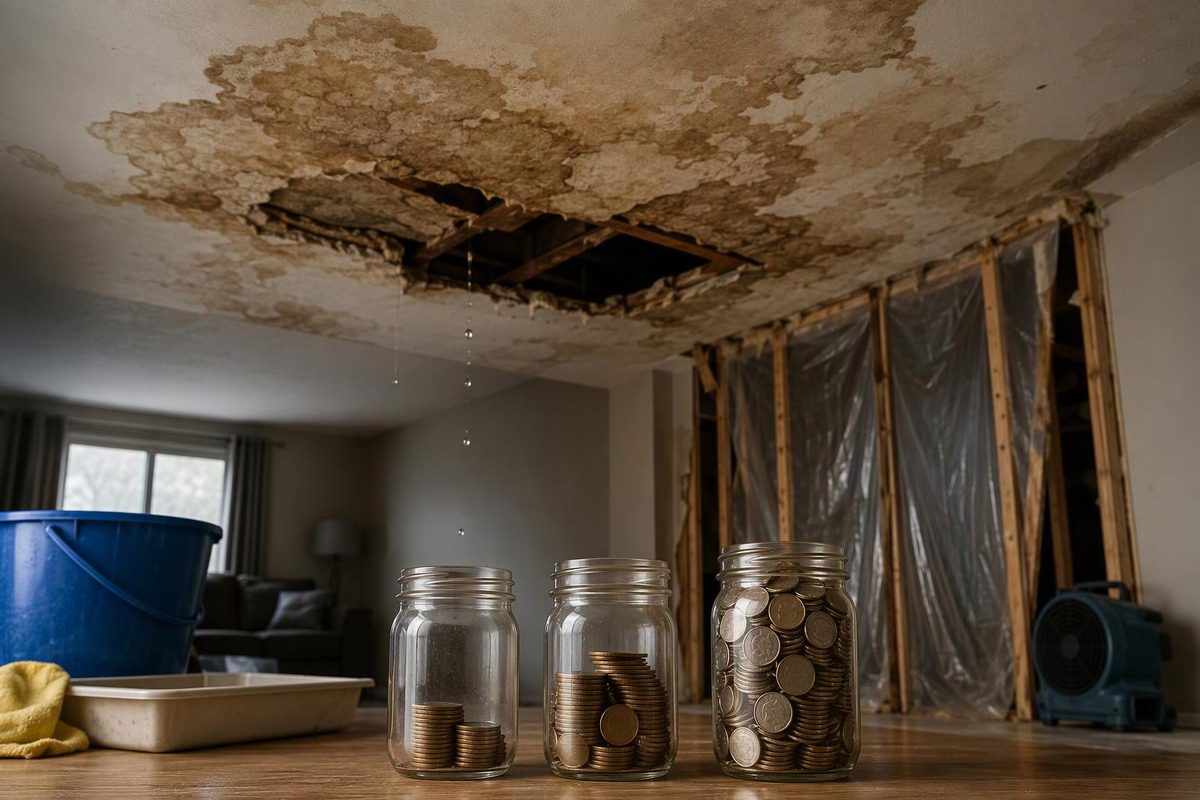
Ceiling water damage repair can cost $200–$500 for a small drywall patch and painting, or $500–$2,500 for work that includes leak repair and ceiling restoration, according to HomeGuide’s cost guide. These are starting benchmarks, not a maximum bill. Extensive drying, structural damage or a major roof problem can make the job substantially more expensive.
Your insurance payout is a separate calculation. It depends on the cause, which expenses the insurer approves as covered, and your deductible, limits and settlement terms. The calculator below separates a conditional insurance payment from your share; it does not determine coverage.
Enter approved covered costs, your deductible and excluded repair costs to estimate your share.
Covered Costs And Your Share
Use insurer-approved amounts, not an unreviewed contractor total. All fields are dollars; enter 0 when there are no excluded costs.
- Estimated insurance payment
- $1,400.00
- Your estimated share
Hypothetical starting example: $2,400 covered costs, $1,000 deductible and $600 excluded costs.
Assumes sufficient applicable limits and replacement-cost payment conditions satisfied. No depreciation, other payment reductions or unentered costs are included. This does not determine whether a loss is covered.
Source: the article’s hypothetical claim example, not market pricing or a policy quote.
Published Costs Cover Different Repair Scopes
As of October 2026, published U.S. cost guides give the following estimates. They describe different scopes of work, so do not add them together or treat them as interchangeable quotes. Local labor rates and the actual damage will affect your price.
| Repair Scope | Published Estimate | What It Covers |
|---|---|---|
| Small water-damaged drywall patch and painting | $200–$500 | Limited ceiling repair |
| Water removal, leak repair, drywall replacement and painting | $500–$2,500 | HomeGuide’s combined-project benchmark |
| Water-damaged ceiling repair, labor and materials | $45–$55 per square foot | Angi’s ceiling repair benchmark; water-source repair is additional |
Sources: HomeGuide’s guide linked above and Angi’s ceiling repair guide, updated May 30, 2026.
For scale, 20 square feet at $45–$55 equals $900–$1,100 for the ceiling repair alone. That is arithmetic using Angi’s rate, not a contractor quote. Ask whether the measured area means the damaged patch, the drywall being removed or the full surface being refinished. For HomeGuide’s combined-project range, confirm the actual leak repair and drying included.
Angi notes that major water damage or structural work can cost $4,500 or more. Ceiling material, access and underlying damage affect the price; plaster and textured finishes can require more work than standard drywall. SERVPRO also distinguishes ceiling repair from separate plumbing, roofing or HVAC repairs.
An Itemized Estimate Shows What The Price Leaves Out
Have the contractor separate these expenses in writing:
| Work | Scope To Confirm |
|---|---|
| Stopping the leak | Diagnosis and plumbing, roof or HVAC repair |
| Drying and cleanup | Water removal, drying equipment, monitoring and disposal |
| Opening and rebuilding | Demolition, drywall, insulation and damaged framing |
| Finishing | Joint treatment, texture matching, primer and paint; patch-only or whole-ceiling painting |
| Other work | Electrical assessment, mold remediation or hazardous-material testing, if needed |
Ask what is excluded and how newly discovered damage will be priced. A cheap patch estimate and a complete restoration estimate may look like competing prices when they are actually different jobs.
Do not repair the finish before resolving the moisture problem. The EPA recommends drying water-damaged areas and items within 24–48 hours to help prevent mold growth; it also advises against painting moldy surfaces before cleanup and drying.
Insurance Coverage Depends On The Cause, Not The Repair Price
For a U.S. homeowners policy, the cause matters more than the stain’s size. Allstate’s water-damage coverage guide explains that sudden, accidental water damage—such as an upstairs pipe bursting and soaking the ceiling below—may fall under dwelling coverage. Ongoing maintenance problems and neglect are typically not covered.
The same guide distinguishes three issues that can change your share of the bill:
- Resulting damage versus the failed component: the ceiling may be covered even when repairing or replacing the source of the leak is not.
- Gradual leakage: damage from unresolved leaks is commonly excluded; check the policy’s wording and any exceptions.
- Flood and backup: standard home policies generally exclude flood damage and outside sewer/drain backup. Separate insurance or optional coverage may be needed.
Mold cleanup can have separate coverage restrictions, too. The Texas Department of Insurance advises consumers to check whether cleanup coverage must be added. Your policy and state rules control the claim; these general distinctions do not establish coverage for a particular loss.
A Covered Ceiling Claim Can Still Leave You Paying For The Pipe
Assume the insurer accepts a sudden pipe leak as a covered event, with these hypothetical expenses and policy terms:
| Item | Amount Or Assumption |
|---|---|
| Insurer-approved drying and ceiling restoration | $2,400 |
| Failed-pipe repair, excluded under this example’s policy | $600 |
| Applicable deductible | $1,000 |
| Dwelling limit | $300,000, with no lower applicable sublimit |
| Settlement basis | Replacement cost, with all payment conditions satisfied |
The insurer pays $2,400 − $1,000 = $1,400. You pay $1,600: the $1,000 deductible plus the excluded $600 pipe repair. The limit does not reduce this payment, but it does not make the excluded repair covered.
The calculator uses this example as its starting point. It assumes the entered covered costs are insurer-approved, applicable limits are sufficient, and replacement-cost payment conditions are satisfied. Your share is the covered amount left unpaid after the deductible, plus the excluded costs you enter. Costs you leave out are not included in the result.
Actual cash value terms can reduce payment for depreciation; replacement cost terms generally do not, subject to policy conditions. The NAIC explains that distinction, and our replacement cost versus actual cash value guide walks through the payout mechanics.
Document The Damage Before Permanent Repairs
Stop the leak safely, photograph the damage, and keep diagnosis reports and emergency-work receipts. If you may claim, notify the insurer promptly and arrange inspection before permanent repairs; do not delay necessary damage prevention. These steps align with the Texas Department of Insurance guidance linked above.
Then compare the contractor’s scope with the insurer’s approved estimate—not just their totals. If covered damage is at or below the deductible, there may be no payment. If hidden damage expands the job, document it and ask the adjuster to review the added scope before it is concealed by new drywall. Our guide to what a water-damage adjuster does explains how your records help check the estimate.