
6 min read ·
Who Pays When Road Debris Damages Your Car
See when a driver or road agency may owe for debris damage, whether collision or comprehensive applies, and what evidence supports an insurance claim.
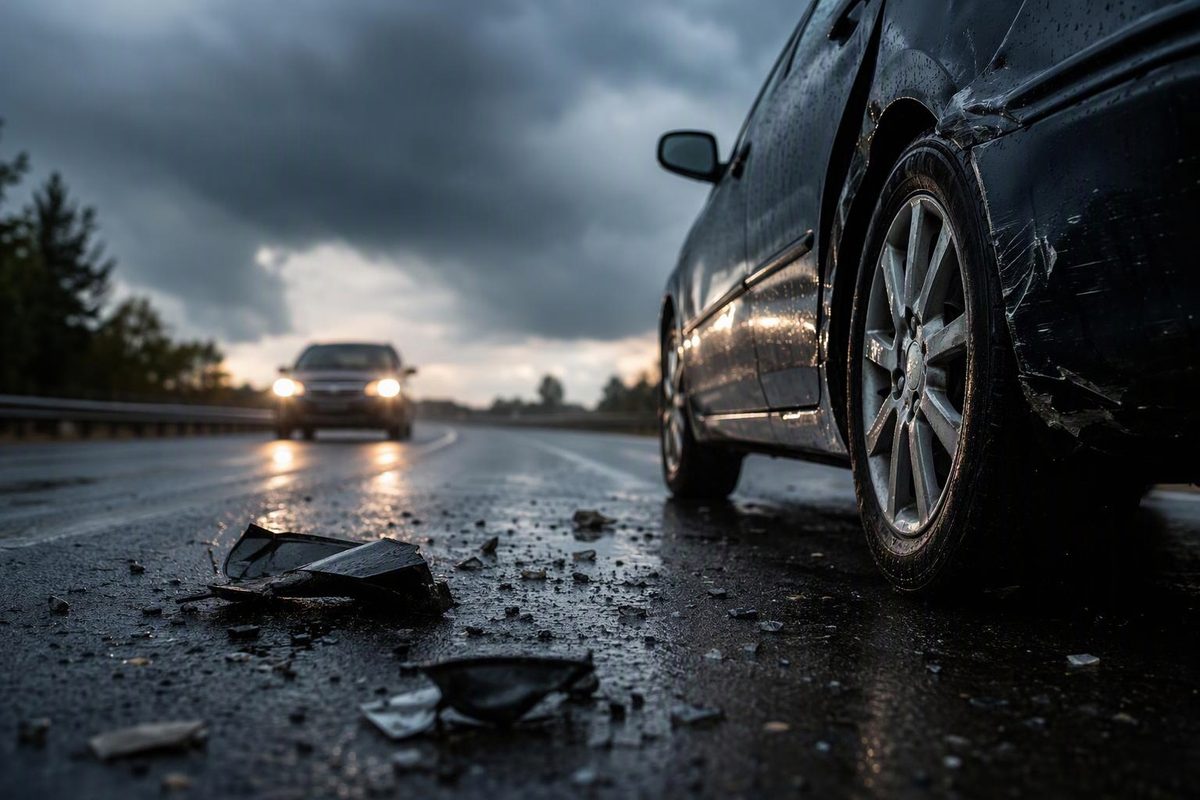
The person or business that negligently caused the debris hazard may be responsible for your damage—but a nearby truck is not proof of fault. You need evidence connecting the damage to that party’s conduct. A road agency is not automatically responsible because the debris was on its road. Your own collision or comprehensive coverage may pay for covered repairs even when you cannot establish who caused the hazard.
Legal responsibility and insurance coverage are separate questions. The first determines who owes; the second determines whether you have a payment route while responsibility is investigated. This guidance is for U.S. drivers; state law and your policy determine the outcome.
Choose how the damage happened and what you know about its source; the tool shows which claim route to check.
Find Your Claim Route
Coverage to Check
Collision
Driving into or over an object is generally a collision starting point. Ask your adjuster to apply your policy wording.
Responsibility Route
A nearby vehicle alone does not establish fault. If the source cannot be established, check your own applicable coverage; liability-only coverage does not repair your car.
Payment depends on coverage, the deductible, limits and exclusions—not just the event label.
Policy and Evidence Caveats
Report whether the object was stationary, falling, flying or bouncing. For tire-only damage, check exclusions: the cited AssuranceAmerica Virginia form excludes damage due and confined to road damage to tires. Glass-deductible treatment varies.
Agency responsibility depends on the jurisdiction and evidence. The Ohio Ross case does not establish a nationwide rule. A hazard report may not be a compensation claim.
Sources: Progressive coverage and windshield guidance; Texas Department of Insurance; AssuranceAmerica Virginia Part D; Ross v. ODOT (2011); Caltrans. Linked in the article.
Another Driver May Owe If Evidence Connects Them to the Debris
An unsecured mattress, spilled gravel or equipment falling from a vehicle gives you a potential claim against whoever was responsible for securing and transporting it. For example, Washington’s unsecured-load law requires loads to be secured against escaping or becoming a highway hazard. It also requires operators to arrange cleanup of fallen objects that obstruct or endanger travel. That is a Washington requirement, not a statement of every state’s law.
The key distinction is debris falling from a load versus an existing road object kicked up by a tire. If all you know is that a rock struck your car while you followed a truck, you have not necessarily proved negligent loading. Record what you actually saw rather than guessing where the rock originated.
If you identify a potentially responsible driver or business, submit your evidence to its insurer. Payment still depends on liability, coverage and available limits. The Texas Department of Insurance warns that another driver’s insurer may dispute fault, assign shared fault or have insufficient coverage. Ask for any denial reason in writing.
A plate number or company name helps identify whom to contact. Footage showing the object leaving that vehicle, or a witness who saw it happen, addresses the harder question: why that party should be responsible.
A Road Agency Is Not Automatically Liable
A maintenance duty is not a promise to reimburse every debris loss.
In the Ohio case Ross v. Ohio Department of Transportation (2011), a driver’s concrete-debris claim failed because she did not establish that ODOT negligently created or maintained the hazard, knew about it, or should have discovered it before her crash. That is an Ohio example, not a nationwide rule, but it shows why the hazard’s history matters.
For an agency claim, identify who maintains that particular road and check its formal claim requirements and deadlines immediately. Evidence of an earlier debris report may help establish the hazard’s history; a photograph taken after your impact does not, by itself, show how long it had been there.
A hazard report is not necessarily a compensation claim. Caltrans explicitly says its government-claims process is an early-resolution process for potential lawsuits, not a reimbursement or insurance program. Do not assume reporting debris to a maintenance line starts the process for recovering your repair costs.
Collision or Comprehensive Depends on How the Impact Happened
The event—not just the label “road debris”—helps determine which coverage applies.
| What Happened | Coverage to Check |
|---|---|
| You drove into or over debris lying in the road | Collision |
| Flying gravel or a falling object struck your car | Comprehensive, also called “other than collision” |
| You swerved around debris and hit a barrier or another car | Collision for your car’s damage |
| A rock chipped only your windshield | Comprehensive and glass-deductible provisions |
Progressive’s coverage explanation distinguishes collision with another vehicle or object from non-collision losses. The Texas insurance regulator’s guide specifically lists flying gravel under comprehensive.
AssuranceAmerica’s Virginia policy form, Part D, classifies missiles and falling objects as other-than-collision losses. That is an example from a particular Virginia policy form; your policy and endorsements may differ. For rock chips, Progressive’s windshield guidance also points to comprehensive, but glass-deductible treatment varies.
These are starting points, not guaranteed classifications. Describe whether the object was stationary, falling, flying or bouncing, and ask the adjuster which policy provision applies. A description such as “a rock hit my car” may leave out the detail needed to classify the loss.
Your own liability-only coverage does not repair your car. It pays qualifying damage you cause to others, as the Texas regulator explains. If no responsible party can be established and you have no applicable coverage, you may have to pay for repairs yourself.
A Deductible Reduces Payment After the Covered Loss Is Determined
Illustrative claim: You run over metal debris. Assume your insurer accepts $1,800 in bumper and underbody repairs under collision, with a $500 deductible. The payment would be $1,300.
The calculation is the accepted covered loss of $1,800 minus the $500 deductible, giving an insurer payment of $1,300.
| Example Item | Amount | Treatment |
|---|---|---|
| Accepted impact repairs | $1,800 | Covered loss before deductible |
| Collision deductible | $500 | Subtracted from covered loss |
| Insurer payment | $1,300 | After deductible |
| Unrelated tire wear | $200 | Excluded from this example |
For the limit, assume the car’s actual cash value is $12,000 and the policy limits the covered loss to the lesser of that value or qualifying repair/replacement cost. Here, the $1,800 repair amount governs before the deductible—not the $12,000 value.
The separate $200 tire-replacement charge in this example is solely for pre-existing wear, unrelated to the impact. It is not part of the covered loss.
AssuranceAmerica’s Virginia form, Part D, provides a concrete example of these valuation provisions and excludes damage “due and confined to” wear and tear or road damage to tires. If debris damaged only a tire, check that wording before expecting a collision payment. Your form and endorsements may differ.
A Deductible Refund Depends on Recovery
Using your policy does not guarantee a deductible refund. Your insurer may pursue the responsible party through subrogation, meaning recovery of what it paid. The Texas Department of Insurance explains that successful recovery may also reimburse your deductible.
You can therefore have a covered claim under your own policy without a proven claim against another driver. Conversely, evidence that another party caused the damage does not establish that its insurer will accept liability or have enough coverage to pay the loss.
Preserve Evidence of the Source, Not Just the Damage
Get to safety before documenting anything. Do not chase a vehicle or enter traffic to retrieve debris. Arrange towing if the car appears unsafe to drive.
Save dashcam footage before it overwrites. Record the time, road, direction, lane, nearby exit or mile marker, plate number and business markings. Photograph the damage and scene only from a safe location. Keep witness contact information and any police-report number.
Separate observation from inference in your report. “I saw metal fall from the trailer and hit my bumper” describes a source and an impact. “I was behind a truck when I heard an impact” does not establish where the object came from. Both should be reported accurately, without filling gaps with assumptions.
Get a repair estimate that separates impact damage from pre-existing problems. That distinction matters for both the amount of a covered loss and any exclusions the insurer applies.
Check Inspection Requirements Before Repairs
Report the loss accurately and promptly. Before authorizing repairs, compare the accepted covered estimate with your applicable deductible and ask whether the insurer needs to inspect the vehicle.
For example, the duties-after-loss section of AssuranceAmerica’s Virginia policy form requires an opportunity to inspect damaged property before repair or disposal. Check your own policy’s requirements rather than assuming that an estimate and photos will always be sufficient.
Ask separately about towing, rental coverage and recovery from another party; do not assume those expenses are included simply because the impact damage is covered. If you are pursuing a road agency, check its compensation-claim procedure as well as your insurer’s process.
The strongest claim evidence shows what caused the damage, where the debris came from, and why a particular party should be responsible. When that source cannot be established, the practical repair route is your own applicable coverage, subject to its deductible, limits and exclusions.