
17 min read ·
What You Could Pay to Fix a Hail-Damaged Car
Published examples put professional repair of an isolated small dent at $75–$200, particularly when the paint is intact and PDR is suitable.
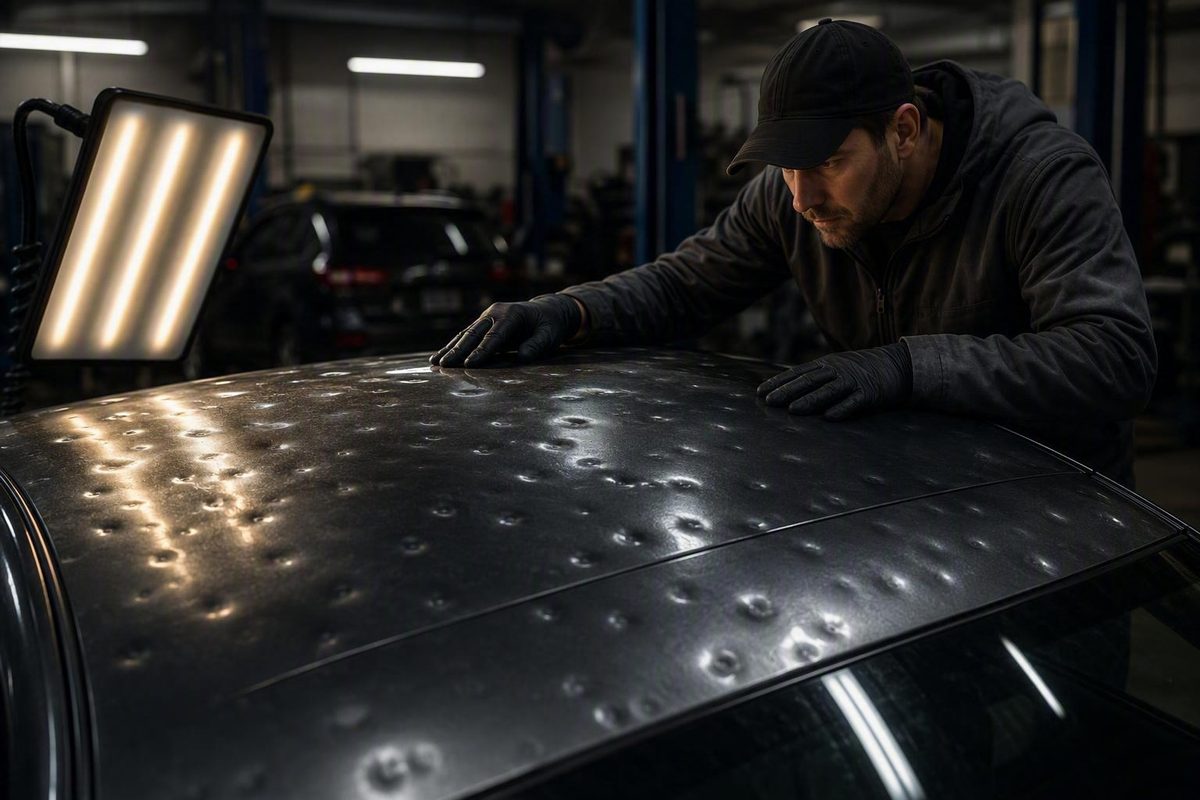
Hail damage repair cost at a glance
A realistic starting point for hail damage car repair cost is:
- Light damage suitable for paintless dent repair (PDR): approximately $500–$1,500
- Moderate damage across several panels: approximately $1,500–$4,000
- Severe whole-vehicle damage: approximately $3,500–$15,000 or more
These tiers are cautious syntheses of estimates published by regional commercial repair providers. They are not independently verified national averages, statistically representative benchmarks, or guaranteed quotes. For example, Southwest Florida provider My Dent Guy lists PDR ranges of $500–$1,500 for light damage, $1,500–$3,500 for moderate damage, and $3,500–$8,000 for severe damage; its conventional body-shop estimates reach $15,000 or more for severe work (regional PDR pricing guide).
The moderate range extends to about $4,000 because Dent Hero, a commercial provider serving the Washington, DC, Virginia, and Maryland region, reports approximately $2,000–$4,000 for the moderate damage it commonly encounters. It also says severe repairs can exceed $10,000, illustrating how market, vehicle, and severity definitions change the result (regional inspection and pricing examples).
| Damage level | Illustrative condition | Likely approach | Provider-reported cost band |
|---|---|---|---|
| Light | A limited number of shallow dents, intact paint, roughly one to three panels | Primarily PDR | About $500–$1,500 |
| Moderate | More dents across several panels, intact paint, possible trim or headliner removal | PDR plus access labor; limited conventional work if needed | About $1,500–$4,000 |
| Severe | Widespread dents, difficult access, high dent count | Extensive PDR, conventional bodywork, or both | About $3,500–$8,000+ |
| Severe with paint, glass, or parts damage | Cracked paint, broken glass, damaged trim, or panels requiring replacement | Conventional repair, refinishing, glass work, and replacement parts | About $8,000–$15,000+ |
Published figures differ sharply because providers serve different markets and use different definitions. Austin-area commercial provider Quality Body Shop lists $150–$600 for minor work and $3,500–$8,000 or more for severe work. That does not necessarily conflict with providers reporting many repairs in the several-thousand-dollar range; the estimates may reflect different dent counts, repair methods, vehicle types, labor rates, and severity categories (Austin-area hail repair estimates).
An isolated small dent may be quoted at approximately $75–$200. Do not multiply that figure mechanically when a storm leaves dozens or hundreds of dents. Hail jobs may be priced by panel, dent-size category, dent concentration, access requirements, and total scope rather than through one universal per-dent rate (small-dent pricing examples).
Most importantly, separate the full repair bill from what you might pay personally. A shop could estimate $6,000 while your final payment consists of a deductible plus any excluded, elective, disputed, or otherwise uncovered work. Conversely, without applicable comprehensive coverage—or when the approved repair is below the deductible—you may be responsible for the full bill.
The dependable number for your vehicle is an itemized, inspection-based estimate. Broad price bands provide orientation, but they cannot account for the actual dent count, panel construction, paint condition, access work, glass, parts, taxes, or policy terms.
The factors that make one hail estimate higher than another
Two cars parked beside each other during the same storm can receive very different estimates. One may have shallow dents in accessible steel panels with intact paint. The other may have deeper dents on an aluminum hood and roof, chipped paint, damaged trim, and a windshield requiring replacement.
Dent count, diameter, depth, and distribution are core pricing inputs. Ten shallow dents concentrated on one accessible panel are not equivalent to 100 mixed-size dents spread across the hood, roof, trunk, doors, pillars, and quarter panels. Larger, deeper, or sharper dents generally require more working time, while dense concentrations can make a panel substantially more labor-intensive.
Estimators commonly inspect damage panel by panel. Specialized lights or reflection boards reveal low spots that ordinary daylight may hide. The inspection can also identify broken parts and the disassembly required to reach the backs of damaged panels.
Panel location and access can be as important as the visible dent. A technician may have straightforward access to the back of a hood. Reaching a roof, pillar, door, or quarter panel may require removal and later reinstallation of a headliner, interior trim, moldings, lights, insulation, or other components. That work may appear as “R&I,” meaning remove and install, on an estimate.
A dent that looks minor from outside can therefore produce two categories of labor:
- Labor to reshape the metal.
- Labor to create safe access and reinstall everything removed.
Paint condition often determines the repair method. When the finish is intact and the metal remains repairable, PDR may avoid sanding, filler, primer, repainting, and color blending. Cracked, chipped, or deeply scratched paint can add conventional body labor, refinishing labor, paint and materials, and blending into adjacent areas.
Panel construction also matters, but there is no universal aluminum surcharge. Aluminum can demand more time and specialized skill than steel. Commercial examples report increases of approximately 10%–30%, but the actual difference depends on the panel, alloy, dent characteristics, access, and technician. Vehicle size, local labor rates, parts availability, storm-driven demand, and specialty construction can also influence the estimate.
Other variables include:
- Greater exterior surface area on a truck, van, or large SUV
- Higher-priced luxury, specialty, or model-specific parts
- Local labor rates and technician availability
- Replacement-part supply and shipping delays
- Regional repair demand following a major storm
- Paint blending needed for an acceptable color match
- Preexisting dents, scratches, or paint damage unrelated to the hail loss
A low estimate that omits those operations is not directly comparable with a complete repair plan.
Four realistic repair-cost scenarios
These scenarios show how the broad ranges might apply. They are illustrations based on commercial provider pricing, not guaranteed prices for a particular vehicle or market.
Scenario 1: A few shallow dents on one accessible panel
Suppose a car has three or four small, rounded dents on the hood. The paint is intact, the dents are not sharply creased, and the technician has straightforward access.
A provider might quote an isolated small dent at approximately $75–$200. That does not mean four visible dents automatically equal $300–$800.
This is the type of loss most likely to remain in the hundreds of dollars, but only an inspection can establish the actual scope.
Scenario 2: Light PDR across approximately one to three panels
Imagine shallow dents on the hood, roof edge, and trunk lid, with no broken paint or glass. An illustrative provider-reported band is $500–$1,500 for light PDR involving approximately one to three panels.
The lower end is more plausible when the dent count is limited and panels are readily accessible. The price can increase if a headliner, trim, insulation, or interior components must be removed to reach the roof. Even without painting, access labor can be a meaningful part of the bill.
Scenario 3: Moderate multi-panel damage with intact paint
Now consider dents across the hood, roof, trunk, and two doors. PDR remains possible because the paint is intact, but the car has substantially more dents and several panels require disassembly.
A cautious synthesized range is approximately $1,500–$4,000. The estimate may include separate entries for each panel, dent-size or concentration categories, roof access, molding removal, headliner removal, and reinstallation.
PR Dents, a northern Colorado commercial provider, publishes the following regional examples:
| Panel | Example PDR range |
|---|---|
| Hood | $300–$900 |
| Roof | $500–$1,800 |
| Door | $200–$700 |
| Fender or quarter panel | $250–$800 |
These are not additive national prices.
Scenario 4: Widespread dents plus cracked paint, glass, or replacement panels
A severe loss may involve hundreds of dents, deep creases, chipped paint, a cracked windshield, broken moldings, and panels that are more economical to replace than repair. Provider estimates indicate that this scope can reach $8,000–$15,000 or more, particularly when extensive conventional bodywork, refinishing, glass, and replacement parts are involved (severe repair-cost examples).
The estimate could include:
- Extensive PDR on repairable panels
- Conventional repair where paint is damaged
- Panel replacement and fit-up labor
- Sanding, filler, primer, color, clear coat, and blending
- Windshield or other glass replacement
- New trim, moldings, lights, clips, or seals
- Removal and installation of interior components
- Sensor inspection or recalibration
- Taxes and shop materials
One commercial provider quotes approximately $300–$1,500 or more for windshield replacement, depending on the vehicle. A vehicle with windshield-mounted driver-assistance equipment may also require recalibration, but the available evidence does not establish a standard national recalibration price.
Paintless dent repair versus conventional body repair
Paintless dent repair reshapes a damaged panel without sanding, filler, or repainting. A technician commonly works from behind the panel with specialized tools. When rear access is unavailable, an exterior glue-pulling method may be possible.
The main signs that PDR may be suitable are:
- The paint remains intact.
- The metal has not been severely stretched or torn.
- The dent can be reached from behind or safely glue-pulled.
- The work can be completed without unacceptable damage to the finish or panel.
Dent diameter alone does not determine eligibility. A broad, shallow dent may be easier to repair than a much smaller but sharply creased dent. Depth, sharpness, body lines, panel edges, stretched metal, previous repairs, and tool access all matter.
Conventional repair is more likely when the vehicle has:
- Cracked, chipped, or deeply scratched paint
- Sharp creases
- Severely stretched or torn metal
- Damage at difficult panel edges or body lines
- Broken glass
- Damaged trim, lights, or attached components
- A panel that cannot be economically restored through PDR
Traditional repair may involve reshaping the panel, applying filler, sanding, priming, painting, and blending.
A technician may be physically capable of performing extensive PDR yet still recommend replacement. If the dent-removal labor would exceed the cost of replacing and refinishing the panel, replacement may be the more economical repair plan.
PDR can eliminate some paint, material, and refinishing charges, but commercial claims that it always saves a fixed percentage should not be treated as guarantees. Eligibility and savings depend on the specific damage. Boyd Autobody, a collision-repair provider, describes PDR as applicable to steel and aluminum when paint and damage conditions permit, while identifying deep damage, torn metal, and chipped or scratched paint as reasons for conventional work (PDR and conventional repair comparison).
The practical question is not simply whether PDR is cheaper. It is which method appropriately restores each panel at a reasonable total cost. A mixed estimate—PDR on some panels and conventional work on others—may be the most sensible plan.
How comprehensive coverage and the deductible change what you pay
Hail damage may be covered when a vehicle has applicable comprehensive coverage and the insurer approves the claim. Payment remains subject to the policy, exclusions, preexisting-damage findings, valuation, deductible, claim decision, and applicable jurisdiction. Commercial industry guidance similarly describes coverage and owner payment as dependent on the relevant policy rather than automatic (hail-estimate and coverage overview).
Keep four figures separate:
- Shop repair estimate: What the repair facility expects the complete work to cost.
- Insurer-approved covered amount: What the insurer recognizes as covered and necessary under its appraisal and the policy.
- Deductible: The policyholder’s assigned share of an approved covered loss.
- Final owner payment: The deductible plus any excluded, unapproved, elective, or otherwise uncovered work.
These figures may not match at the beginning of the process.
Below-deductible example: Suppose a shop estimates $600 of damage, the insurer approves that amount as covered, and the applicable deductible is $1,000. The approved loss is below the deductible, so the policy would ordinarily provide no repair payment.
Moderate-loss example: If the insurer approves $2,200 of covered repairs and the deductible is $500, the owner may pay $500 while the insurer pays $1,700. This matches an illustration published by the Austin body shop cited earlier, although the actual result remains policy-specific.
Major-loss example: If an insurer approves a hypothetical $10,000 covered repair and the applicable deductible is $1,000, the owner may pay $1,000 and the insurer may pay the remaining $9,000. That assumes all remaining operations are covered and approved; unrelated prior damage, elective work, or disputed items could increase the owner’s payment.
A deductible is not necessarily an extra charge added on top of the repair bill. In these examples, it is the portion of an approved covered loss allocated to the policyholder. When the approved loss is below the deductible, there may be no insurer payment; when it is above the deductible, payment of the covered remainder still follows the policy.
An owner might consider paying directly or leaving cosmetic dents unrepaired when:
- There is no applicable comprehensive coverage.
- The estimate is below the deductible.
- The approved covered amount is only slightly above the deductible.
- The vehicle is older or low in value.
- The paint is intact and there are no glass, rust, functional, or safety concerns.
That list does not determine whether filing a claim is appropriate for every owner. Review the declarations and policy for the applicable coverage and deductible rather than relying on a shop’s statement that insurance will “cover everything.”
Treat deductible-assistance or “zero out-of-pocket” advertising as a conditional commercial offer. Ask for written eligibility requirements, insurer-related conditions, contractual terms, and a clear explanation of how the offer is applied. Verify any applicable rules before authorizing work rather than assuming the promotion is available or permissible in every situation.
Online calculators, insurer appraisals, shop estimates, and supplements
An online hail calculator is a preliminary guide. It commonly asks for vehicle type, affected panels, dent sizes, and dent counts. Some tools divide dents into categories such as dime, nickel, quarter, or half-dollar size.
Owners can undercount dents or misjudge their size and depth. Reflections, paint color, dirt, and ordinary lighting may hide damage, making self-entered estimates especially uncertain when the roof or multiple side panels are affected.
Calculators may omit:
- Disassembly and reassembly
- Headliner or trim removal
- Replacement moldings and other parts
- Paint and materials
- Glass
- Sensor calibration
- Taxes
- Hidden dents
- Conventional bodywork where paint is damaged
For example, StormWise’s commercial calculator asks for vehicle details, damaged panels, dent counts, and average dent sizes, but its calculation covers PDR and excludes replacement parts and disassembly or reassembly labor. The provider says an in-person inspection is required to confirm final pricing (calculator scope and limitations).
It helps to distinguish the documents you may receive:
- Online estimate: A rough, self-entered guide based on limited information.
- Insurer’s initial appraisal: The insurer’s first documented assessment of covered damage and repair operations.
- Shop’s itemized inspection: The repair facility’s panel-by-panel scope based on its inspection and intended repair method.
- Supplement: An added estimate for necessary damage or operations identified after the initial appraisal or during repair.
- Final invoice: The completed record of work performed, parts, materials, taxes, and adjustments.
Different totals do not automatically prove that a shop is overcharging or that an insurer is underpaying. Each document may reflect a different inspection stage or scope. A shop may identify dents under specialized lighting, determine that a headliner must be removed, or find damaged clips after disassembly. Industry guidance also notes that hidden or initially omitted damage can lead to a supplemental estimate during repair.
When comparing estimates, check whether each includes:
- Every damaged panel
- Dent-size or severity category
- PDR labor
- Conventional body labor
- Access labor
- Removal and installation
- Replacement parts
- Paint labor and materials
- Glass
- Calibration
- Taxes and fees
- Deductible
- Specifically excluded or uncovered work
- Assumptions about anticipated supplements
Do not treat a calculator result as a binding shop quote, insurer-approved amount, or final invoice. Obtain an in-person inspection before using the figure to decide whether to repair or pursue an insurance claim.
Repair time, safety concerns, and possible total loss
One provider estimates PDR timelines of 1–2 days for light damage, 3–5 days for moderate damage, and 5–10 days for severe whole-vehicle damage Hail Damage Repair Cost 2026: PDR Pricing Guide | My Dent Guy. These are repair-time estimates, not guaranteed calendar turnaround periods.
The overall process can take longer because of:
- Parts availability
- Paint preparation and curing
- Glass replacement
- Calibration
- Insurer review
- Supplement consideration
- Shop capacity
- Post-storm backlogs
- Additional damage found after disassembly
Separate cosmetic dents from functional damage. Shallow dents with intact paint may primarily affect appearance. Broken glass, loose panels, damaged lights, doors that no longer close correctly, or impaired visibility require more immediate attention.
Arrange a professional assessment before driving if the windshield obstructs visibility, doors do not close or latch correctly, body panels are loose, or other damage may affect safe operation. Untreated paint chips can expose metal and create a rust concern, unlike a shallow dent with intact paint (hail-related safety and paint concerns).
Severe hail damage can also lead to a total-loss evaluation. Conceptually, the insurer compares the complete repair economics with the vehicle’s value using its methodology, policy terms, and applicable law. Commercial repair sources report that severe cases can result in a total-loss determination, but they do not establish one universal percentage that applies to every vehicle and jurisdiction.
For an older or lower-value vehicle, consider:
- Complete repair cost
- Insurer valuation
- Deductible
- Paint condition
- Glass and functional damage
- Rust exposure
- Parts availability
- Whether the insurer treats the vehicle as repairable or a total loss
Cosmetic appearance alone does not answer the economic or safety question.
What to do before authorizing a hail repair
Start with a pre-estimate worksheet. Walk around the vehicle in good light and record:
- Every visibly affected panel
- Approximate dent sizes and counts
- Paint chips, scratches, or cracks
- Broken glass
- Damaged trim, moldings, or lights
- Loose components
- Doors, trunk lids, or hoods that do not close normally
- Warning lights or other functional problems
Take dated photographs before repair. Capture the entire vehicle, each affected side, and close-ups of visible damage. Photographs preserve a useful record, but they may not reveal every shallow dent or establish the complete repair scope.
Request an itemized inspection that distinguishes:
- PDR
- Conventional body repair
- Access labor
- Removal and installation
- Replacement parts
- Paint and materials
- Glass
- Calibration
- Taxes and fees
- Anticipated supplements
- Work expressly excluded from the quote
When practical, compare more than one qualified in-person estimate—especially if you will pay a large repair bill yourself or there is a substantial difference between the insurer’s and shop’s scopes. Compare equivalent work rather than choosing the lowest headline figure.
Useful questions include:
- Is each panel steel or aluminum?
- Must the headliner, trim, electronics, or interior components be removed?
- Is the paint fully intact?
- Are any dents too sharp, deep, or stretched for PDR?
- Would replacing and refinishing a panel cost less than repairing it?
- Does the quote include glass, moldings, clips, paint blending, taxes, and calibration?
- What is excluded?
- How will necessary added costs be documented and handled?
- What warranty applies to the completed work?
- What conditions apply to any loaner, deductible assistance, or promotional offer?
If insurance is involved, confirm the applicable comprehensive coverage, deductible, insurer-approved amount, and uncovered work before authorizing repairs. Keep the initial appraisal, shop estimate, supplements, approvals, and final invoice together.
Read every condition attached to deductible assistance, loaner vehicles, and warranties. A promotion does not necessarily reduce the underlying repair bill, and benefits may carry eligibility requirements or contractual restrictions.
Ultimately, the best estimate is vehicle-specific and inspection-based. A generic average cannot account for your panels, paint, access needs, parts, local labor market, or policy.
Frequently asked questions
How much does it cost to repair one small hail dent?
Published examples place professional repair of an isolated small dent at approximately $75–$200, particularly when the paint is intact and PDR is suitable. Depth, sharpness, location, panel material, and access can move the price (small-dent repair-cost guidance).
Do not multiply that rate across a storm-damaged vehicle without an inspection. Once there are many dents, shops may use panel-based or severity-matrix pricing and add access labor.
Is hail damage covered by comprehensive car insurance?
It may be covered when the policy includes applicable comprehensive coverage and the insurer approves the hail loss. Coverage and payment still depend on policy language, exclusions, deductible, preexisting damage, insurer findings, and jurisdiction.
Check your declarations and policy rather than relying on a generic coverage statement from a repair provider.
Is it worth filing a claim when the repair estimate is below the deductible?
If the insurer-approved covered repair is below the deductible, the policy would ordinarily produce no repair payment. That may make direct payment or leaving minor cosmetic damage unrepaired worth considering.
The decision remains personal and policy-specific. Consider whether the estimate is complete and whether paint, glass, or functional components are damaged. Review your own policy for any applicable conditions rather than assuming the estimate alone determines the correct decision.
Can a hail-damage calculator give an accurate final repair price?
Usually not. A calculator can provide a rough starting point based on vehicle type, affected panels, dent sizes, and dent counts. It cannot reliably account for missed dents, difficult access, hidden damage, paint condition, replacement parts, disassembly, glass, calibration, taxes, or supplements unless those elements are specifically included.
Treat the result as preliminary and obtain an itemized in-person inspection before making a repair or claim decision.
When is a hail-damaged car considered a total loss?
A hail-damaged vehicle may be treated as a total loss when the insurer determines that repair is not economical under its valuation method, policy terms, and applicable law.
There is no universal 70%, 75%, 80%, or other threshold that applies to every vehicle and claim. Ask the insurer for the valuation and calculation used for the specific car.
Hail repair can range from a small PDR job to a five-figure reconstruction. Document the damage, obtain an itemized in-person inspection, separate the complete repair bill from the insurer-approved amount and deductible, and verify coverage under the actual policy before authorizing work.
Insurance Roster describes its material as general information intended as a starting point. Its terms also state that coverage, claims, and deductible rules vary. This guide is general education, not individualized insurance, legal, financial, or repair advice.