
23 min read ·
What Makes a Defect Hidden—and Why That Distinction Matters
An inspector's failure to identify a condition does not by itself prove it was latent or that the inspector failed to perform the agreed work competently.
The plain-language definition of a latent defect
A latent defect is a hidden or concealed fault that would not be discovered through a reasonable, ordinary, or customary inspection. It can affect real property or personal property, including buildings, land, legal title, machinery, and consumer goods. Cornell Law School’s Legal Information Institute uses this general latent defect definition and contrasts it with a patent defect that ordinary care and prudent inspection could reveal.
The central question is not simply, “Did the buyer or owner notice the problem?” It is:
Could an inspection reasonably appropriate to the circumstances have found it?
That distinction matters because finding a defect after buying a home, accepting construction work, or using a product does not automatically make the condition latent. A visible problem may have been overlooked. An inspection report may have identified it, but the reader may not have understood its significance. Stains, cracks, odors, unusual noises, repeated failures, or other warning signs may also have indicated a need for further investigation.
Conversely, a condition may remain hidden even after a careful standard inspection. It could be behind drywall, below a foundation, inside machinery, underground, or within title records that require a different form of review.
Four related concepts should be kept separate:
- Hiddenness: Is the physical condition or legal problem concealed from ordinary view?
- Reasonable discoverability: Would an inspection appropriate to that situation have revealed it?
- Materiality: Is the problem significant to value, use, safety, health, function, or enjoyment?
- Intentional concealment: Did someone know about the problem and take steps to hide or misrepresent it?
A hidden defect is not necessarily serious. A small internal flaw may be latent even if it is inexpensive to repair. A serious defect can also be patent: a large open crack, visibly damaged support, or exposed electrical damage may be consequential without being concealed.
Hidden also does not mean known to a seller, builder, manufacturer, or other party. Nor does it necessarily mean someone deliberately covered up the problem. Latency concerns discoverability; concealment concerns a person’s knowledge and conduct. Those issues may overlap, but one does not prove the other.
The exact definition and consequences vary by jurisdiction, contract, warranty, insurance policy, and type of claim. A jurisdiction-specific real-estate rule may incorporate seller knowledge, materiality, or danger to health. A construction provision may focus on whether the defect existed at completion. A product warranty may define covered defects differently, while an insurance policy may use “latent defect” in an exclusion. The general definition is therefore a starting point, not a complete answer about disclosure, responsibility, remedies, or coverage.
Latent defects versus patent defects
A patent defect is visible or reasonably discoverable through ordinary care and a prudent inspection. A latent defect remains concealed despite the inspection reasonably expected in that setting. This latent-versus-patent distinction is widely used in property and construction discussions, although classification always depends on the facts and inspection context.
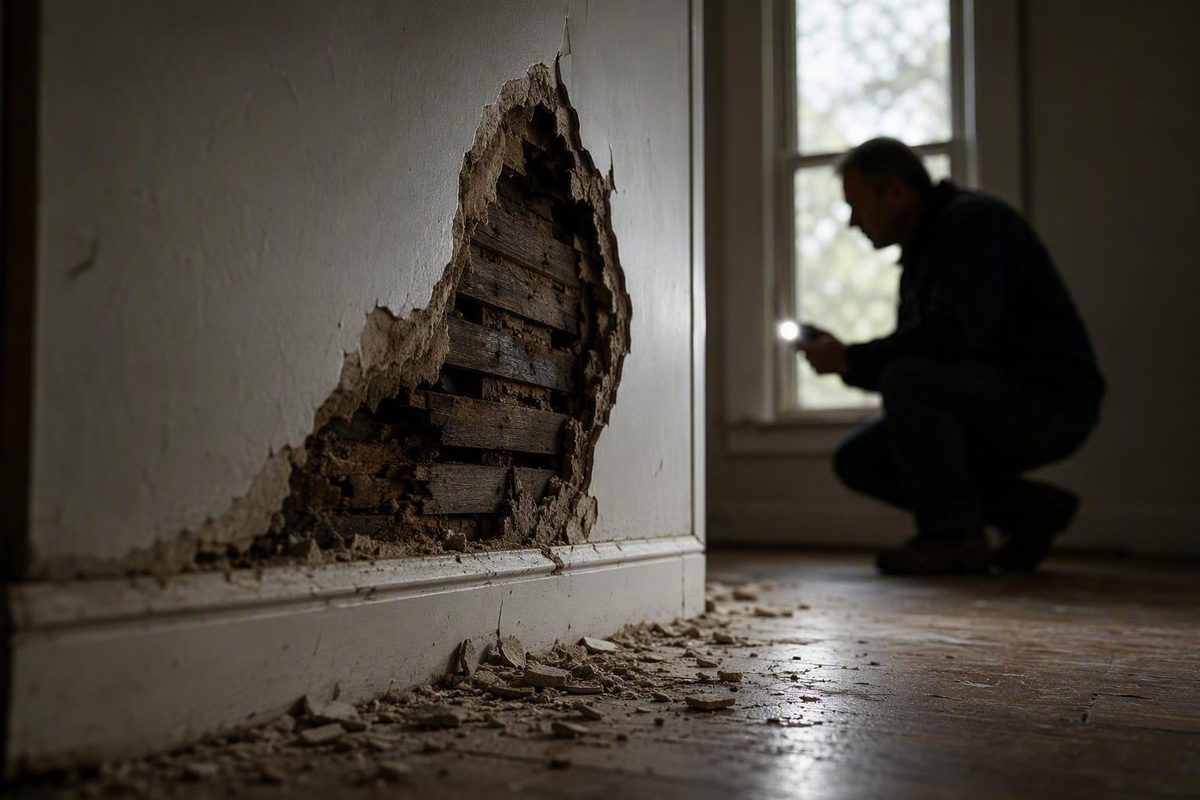
A broken window, obvious hole in a wall, or plainly visible surface damage is normally a patent defect because an ordinary walkthrough should reveal it. But even a seemingly straightforward example can become fact-sensitive.
| Consideration | Latent defect | Patent defect |
|---|---|---|
| Visibility | Hidden, concealed, or inactive | Open, visible, or apparent |
| Reasonable discoverability | Not discoverable through the inspection reasonably appropriate to the circumstances | Discoverable through ordinary care and a prudent inspection |
| Typical timing of discovery | Often found after use, testing, weather, failure, or opening a concealed area | Often identified during a walkthrough, routine inspection, delivery review, or completion review |
| Need for specialized investigation | May require specialist knowledge, equipment, testing, records review, or invasive investigation | Often identifiable without specialized testing, although expert assessment may still be needed to determine severity |
| Representative examples | Concealed pipe defect, internal machinery fault, hidden foundation deficiency, underground contamination | Broken window, exposed damage, obvious wall opening, visibly missing component |
Symptoms and causes may be classified differently
A visible symptom does not necessarily reveal its underlying cause. A ceiling stain, for example, may be patent because anyone can see it. A defective plumbing connection behind the ceiling may remain concealed.
The underlying cause is not automatically latent, however. Construction guidance recognizes both that latent conditions may require specialist knowledge or testing and that warning signs can justify further investigation (Construction Front).
The same distinction may arise with:
- A visible wall crack and a concealed foundation deficiency
- A musty odor and hidden mold behind finishes
- A recurring tripped breaker and defective wiring inside a wall
- An attic water mark and an installation problem beneath roofing materials
- Abnormal machinery noise and an internal clutch defect
A symptom may provide notice that something is wrong without revealing the exact cause, age, extent, or necessary repair. Whether the cause remained reasonably undiscoverable is therefore a fact-sensitive question.
A missed defect is not necessarily a latent defect
An inspector’s failure to report a condition does not prove that it was latent. The condition may have been visible but overlooked. It may instead have been outside the agreed inspection scope, within an inaccessible area, behind finished surfaces, or detectable only through testing that was not part of the inspection.
A useful classification framework asks:
- Was the condition itself visible?
- Were there visible, audible, or otherwise noticeable warning signs?
- Was the affected area reasonably accessible?
- What did the inspection agreement include or exclude?
- Would an ordinary inspection have found the condition?
- If warning signs existed, would an appropriately specialized investigation have found it?
- Was the condition genuinely undiscoverable, or was it simply missed?
The answer may change over time. A concealed defect can remain latent before symptoms arise but become more reasonably discoverable after cracking, staining, movement, odor, leakage, or repeated malfunction appears.
Common examples across homes, construction, goods, land, and title
Latent defects are not limited to structural flaws. They can involve building systems, materials, workmanship, machinery, environmental conditions, land, or legal rights. Every example below is only potentially latent. Visibility, access, warning signs, inspection scope, and the circumstances determine the classification.
Homes and buildings
Potential examples include:
- Concealed foundation deficiencies: Reinforcement, soil preparation, drainage, or foundation work may be hidden below grade or behind finishes. Existing cracks, movement, or sloping surfaces could create a reason for closer investigation.
- Plumbing leaks behind walls: A faulty connection or poorly installed pipe may remain undetected until water escapes. Stains, dampness, odors, or prior repairs may make the problem more discoverable.
- Faulty wiring: Improper connections or damaged conductors can be concealed inside walls or equipment. Exposed wiring, recurring breaker trips, scorching, or malfunctioning fixtures would be warning signs.
- Hidden mold: Growth behind drywall, flooring, cabinetry, or insulation may not be apparent during a non-invasive inspection. Mold visible on an accessible surface is not inherently latent.
- Termite damage: Damage inside framing may remain concealed, while visible tubes, damaged wood, discarded wings, or a prior infestation report may justify a focused pest inspection.
- Roof leaks without readily observable signs: Defective flashing or another hidden installation problem may not be apparent in dry weather. Attic stains or damaged ceilings can make further investigation reasonable.
A crack, leak, mold condition, or electrical problem is therefore not automatically latent. The practical question is whether an appropriate inspection could reasonably have found the condition at the relevant time.
Construction defects
A concealed construction defect may originate in:
- Design
- Materials
- Workmanship
- Installation
- Coordination between trades
- Departure from plans or specifications
The result may affect integrity, safety, function, durability, or appearance. Improperly installed waterproofing might remain behind a finished wall, for example, while inadequate fastening may be concealed beneath roofing or cladding. A construction-law overview identifies design, materials, workmanship, and installation as possible sources and notes that professional inspection, testing, or monitoring may be needed to investigate concealed defects (Tishkoff PLC).
Construction disputes often require detailed investigation because the visible failure may have several possible explanations. Finding one hidden imperfection does not necessarily establish that it caused all the observed damage.
Consumer goods and machinery
A latent defect can exist inside a product even when its exterior appears normal. An internal machinery weakness, defective electrical connection, or lawnmower clutch fault may become apparent only after ordinary use.
Failure after delivery does not by itself prove that a product was defective when delivered. Product records, testing, repair findings, and examination of retained components can help distinguish among those possibilities.
The expected inspection also differs from a property inspection. A consumer ordinarily cannot dismantle a new appliance or machine before purchase.
Land and environmental conditions
Potentially latent land conditions include concealed contamination, buried waste, an underground storage tank, unstable subsurface material, or another underground condition that ordinary viewing would not reveal.
Whether environmental or subsurface investigation is reasonable depends on context. Due diligence for an industrial site will not necessarily resemble an ordinary residential walkthrough.
Title and easements
A latent title defect is conceptually different from a physical defect. It concerns legal rights in property rather than the condition of a structure. Examples may include an undisclosed easement, a competing ownership claim, or another title problem not apparent from physically viewing the land.
A pristine building can therefore be affected by a title problem, while a physically damaged building can have clear title. Both may be described as involving defects, but the necessary evidence, duties, and potential remedies differ.
How a hidden defect can remain dormant and later appear
A latent defect may exist for years before discovery. Some conditions become apparent only after ordinary use, seasonal movement, repeated loading, severe weather, opening a concealed area, or development of related damage.
A simple timeline is:
- Creation or prior existence: A flaw arises during design, manufacture, construction, installation, repair, or an earlier event.
- Dormant period: The condition exists without an obvious symptom.
- Warning sign or triggering event: Use, rain, heat, movement, impact, or deterioration exposes a weakness.
- Investigation: An owner, contractor, inspector, or specialist examines the symptom.
- Discovery: The concealed condition is identified, at least provisionally.
- Notice: Relevant parties, warranty providers, or insurers are informed where appropriate.
- Possible claim or resolution: The parties investigate repairs, responsibility, coverage, and available options.
Consider inadequate foundations that later produce settlement or subsidence. The original condition might involve design, support, materials, drainage, soil conditions, or preparation. Later symptoms may include cracked finishes, sloping floors, sticking doors, or structural movement.
The symptoms are not the same as the original condition. Resulting damage may also be different from both. A dispute can therefore involve three layers:
- The original condition, such as inadequate foundation work
- The manifestation, such as settlement
- The resulting damage, such as cracked walls or damaged flooring
Concealed plumbing offers another illustration. A fitting may have been installed incorrectly inside a wall but remain dry or leak too slowly to create an observable sign. Later, water escapes in sufficient volume to stain a ceiling. Opening the wall then reveals the fitting and associated water damage.
A repair professional may identify poor installation, but records and specialist analysis may still be needed to estimate age and connect the condition to the loss.
Relevant historical evidence can include:
- Construction drawings and specifications
- Permits and inspection records
- Product serial numbers and manufacturing information
- Earlier photographs or property listings
- Maintenance and repair invoices
- Prior complaints
- Weather and loss records
- Monitoring data
- Samples or removed components
An investigation may also need to distinguish an original defect from aging, wear, corrosion, inadequate maintenance, later modifications, or unrelated damage. A component can be both old and defective, but age alone does not show that it was defective from the beginning.
Some definitions in particular construction contexts require the defect to have existed when the work was completed. For example, a UK-focused legal glossary describes an inherent building defect as present at completion even if it manifests years later (LexisNexis). That formulation should not be assumed to govern every property, product, warranty, insurance, or construction dispute.
Discovering a defect is different from proving responsibility
Calling a condition a latent defect does not establish liability. Responsibility must be evaluated role by role because sellers, builders, contractors, designers, manufacturers, real-estate professionals, and inspectors may have different contractual or legal duties.
A careful analysis may ask:
- Did the condition exist at the time relevant to the particular claim?
- Was it reasonably discoverable?
- Was it material under the governing rule or contract?
- What caused it?
- Who knew about it, and when?
- Did anyone make a false statement or actively conceal the condition?
- What contract, warranty, disclosure, or professional obligation applied?
- Did the condition cause the claimed loss?
- Were applicable notice and filing requirements met?
The answers depend on the jurisdiction, documents, evidence, and type of claim. A general latent-defect definition cannot resolve them.
Sellers and real-estate professionals
Seller responsibility is jurisdiction- and transaction-specific. Potentially relevant considerations include actual knowledge, the condition’s materiality, statements made during the transaction, alleged concealment, disclosure documents, and the purchase agreement. Some legal frameworks focus on known defects, while others use additional or different standards.
A seller may genuinely be unaware of a hidden condition and therefore unable to disclose factual information the seller does not possess. In one real-estate context, a law-firm explainer states that a seller cannot disclose a latent defect of which the seller is unaware, while separately addressing known dangerous or uninhabitable conditions; that discussion should not be generalized beyond its legal and factual setting (SorbaraLaw).
Active concealment is a separate issue from latency. Painting over decay, covering water damage with new flooring, blocking access, or giving knowingly false assurances may support allegations of concealment or misrepresentation. Whether that conduct creates liability depends on the governing law and proof of the required elements, such as knowledge, materiality, reliance, and causation. Examples of alleged affirmative concealment are discussed in Offit Kurman’s homebuyer overview.
A real-estate professional’s position may differ from the seller’s. The relevant inquiry may include what the professional knew, what was communicated, what duties applied locally, and whether the professional made or repeated an inaccurate statement. Liability should not be inferred merely from participation in the transaction.
Inspectors
For an inspector, the central distinction is between a genuinely undiscoverable condition and one that a competent inspection within the agreed scope should reasonably have identified or flagged for further evaluation.
The report may document those limitations and recommend specialist review when warning signs fall outside the inspector’s expertise.
Describing a condition as hidden does not resolve whether an accessible symptom was overlooked. Relevant evidence may include:
- The inspection agreement and applicable standard of practice
- Access to the affected area
- Weather and operating conditions
- Photographs and field notes
- Visible warning signs
- Recommendations for further evaluation
- Whether the issue was within the agreed scope
- What a competent inspector could reasonably have observed under the conditions
An inspection’s failure to identify a condition does not, by itself, prove either that the defect was latent or that the inspector failed to perform the agreed work competently.
Builders, contractors, designers, and manufacturers
Potential responsibility may involve design, materials, workmanship, installation, departure from plans, product instructions, warranties, or specific contractual requirements.
Causation remains a separate question. A concealed construction detail may be imperfect without causing the claimed damage. Conversely, one loss may have several contributing causes. A leak might involve installation, weather, maintenance, and later alteration. Technical investigation may be required to distinguish among them rather than attributing every expense to the first hidden condition discovered.
Possible remedies are not automatic
Depending on the governing law and documents, a claimant may seek outcomes such as:
- Repair or replacement
- Damages
- Refund
- Price adjustment
- Warranty relief
- Rescission
- Revocation of acceptance for qualifying goods
- Mediation, arbitration, or negotiated resolution
These are possible categories of relief, not guaranteed results. Availability may depend on the transaction, contract, warranty, jurisdiction, evidence, causation, defenses, notice, and timing. Cornell’s legal reference, for example, describes possible damages, refunds, replacement, and revocation of acceptance in particular property and goods contexts rather than promising any remedy in every case.
What evidence can show that a defect was truly latent
Proof is easier to evaluate when divided into specific questions rather than reduced to the broad assertion that “the defect was hidden.”
| Issue to examine | Potentially useful evidence |
|---|---|
| Did the defect exist earlier? | Specialist reports, dated photographs, construction records, product records, samples, testing, permits, prior repair findings, earlier complaints |
| Was it reasonably discoverable? | Original inspection report, transaction photographs, inspection scope, access limitations, condition at the time, visible warning signs, specialist recommendations |
| What caused the failure? | Engineering analysis, product or laboratory testing, destructive or non-destructive examination, moisture mapping, repair observations, retained components |
| Who knew what, and when? | Disclosures, emails, messages, internal memoranda, prior complaints, maintenance records, repair invoices, earlier incidents, contractor communications |
| What documents govern the dispute? | Purchase agreement, construction contract, warranty, inspection contingency, disclosure form, change orders, policy documents, notice and dispute-resolution provisions |
| What loss resulted? | Repair estimates, invoices, photographs, valuation material, relevant temporary accommodation records, and evidence connecting each expense to the condition |
Proving prior existence and cause
A current photograph can document damage but may not show when the underlying condition arose. Specialist analysis may consider whether corrosion, decay, movement, installation marks, fracture patterns, or material conditions are consistent with a long-standing problem.
Testing may be destructive or non-destructive. The appropriate method depends on urgency, safety, cost, and the nature of the problem.
Repair findings can also be important. When a concealed space is opened, the condition should be documented before it is changed when that can be done safely and without allowing avoidable damage to continue. Useful photographs commonly include the wider location, close details, layers removed, connections, labels, and the position of components—not only the final damaged part.
Proving reasonable discoverability
The original inspection report can be central, but it should be considered alongside contemporaneous evidence such as:
- Listing and transaction photographs
- Video of accessible areas
- Weather during the inspection
- Whether utilities and systems were operating
- Areas identified as inaccessible
- Furniture, storage, flooring, or finishes covering the condition
- Statements limiting the inspection scope
- Recommendations for specialist review
- Evidence of odors, stains, cracks, movement, or repeated failures
This material may show whether the condition was concealed and whether warning signs should have prompted further inquiry. It may also demonstrate that the problem became substantially more apparent after the inspection.
Proving knowledge or concealment
The mere existence of a problem does not prove that a seller, contractor, or another party knew about it. More direct evidence might include earlier repair invoices, repeated complaints, prior water incidents, communications with contractors, internal records, or photographs showing that the defect had previously been exposed.
Fresh paint, flooring, or finishes are not automatically evidence of concealment. People renovate for ordinary reasons. Timing, location, communications, and the relationship between the work and the hidden condition matter.
Proving loss and causation
Repair expenses should be connected to the defect rather than combined indiscriminately with upgrades or unrelated maintenance. If a wall must be opened to repair a pipe, an estimate may separate investigation, access, pipe work, drying, remediation, restoration, and optional improvements.
Different specialists may need to answer different questions:
- Could the condition reasonably have been found earlier?
- Did that condition cause the damage and expense being claimed?
A home inspector may address inspection scope. An engineer may analyze movement. An electrician may evaluate wiring. An environmental professional may assess contamination. A product specialist may examine machinery.
When safety and reasonable loss mitigation permit, document the original condition before irreversible repairs. Follow the instructions of emergency services, utilities, manufacturers, and appropriately qualified professionals where immediate hazards or continuing damage are involved. If parts must be removed, photographs, labels, samples, and retained components may preserve information that would otherwise disappear.
How latent-defect language can affect property insurance
Insurance analysis begins with the actual policy, not the general legal definition. Some all-risks property policies typically exclude loss involving a latent defect, but the wording and interaction with other policy provisions determine how that exclusion applies (IRMI).
Separate three questions:
- Is repair or replacement of the defective component covered?
- Is separate ensuing or resulting damage covered?
- Does another exclusion, limitation, deductible, endorsement, or condition affect the claim?
IRMI illustrates the distinction using improperly treated roof shingles. In that example, replacing the defective shingles is excluded, while damage from a later fire is not barred by the latent-defect exclusion. The example demonstrates how a policy may distinguish defective property from a later loss; it does not promise that another policy will cover either part of a claim.
The analytical layers are different:
- The shingles are the allegedly defective property.
- Their decay is the manifestation of the defect.
- A later fire is a separate event causing additional damage.
- Other policy terms may still affect coverage for the fire.
- Limits and deductibles can affect payment even if coverage applies.
A concealed plumbing loss may require the same separation. That does not mean water damage is automatically covered. The cause, event sequence, applicable exclusions, maintenance history, reporting, and policy language may all matter.
When reviewing a policy, locate:
- Declarations: The insured property, policy period, limits, and deductibles
- Definitions: Relevant meanings assigned by the policy
- Insuring agreement: The basic grant of coverage
- Exclusions: Potentially relevant defect, deterioration, workmanship, water, mold, or earth-movement provisions
- Exceptions or ensuing-loss language: Wording that may preserve limited coverage for a separate loss
- Endorsements: Changes that add, remove, or modify policy terms
- Conditions: Requirements concerning notice, mitigation, inspection, records, and cooperation
Do not assume that insurance always excludes the defective item, always covers resulting damage, or pays to correct defective work. Coverage depends on the policy and facts.
Insurance Roster explains insurance wording as general education, so its guides are a starting point rather than a substitute for reviewing the policy. Its Terms & Conditions also state that coverage, claims, and deductibles vary by policy and jurisdiction and that the content is not insurance, legal, or financial advice.
What to do after finding a suspected latent defect
The following checklist can help preserve information, identify controlling documents, and organize the next steps.
-
Respond to immediate danger first. If the condition may present an urgent hazard, follow instructions from emergency services, the relevant utility, the manufacturer, or an appropriately qualified professional. Do not prioritize evidence preservation over personal safety.
-
Take reasonable steps to limit continuing damage. Obtain appropriate professional guidance for urgent mitigation. Avoid improvising technical work that could create additional danger or make the condition harder to evaluate.
-
Document the condition before changing it when circumstances allow. Photograph and video the affected area, visible symptoms, and overall location. Use wide views and close-ups. If an assembly is opened by a qualified person, document each stage and the position of removed components when practical.
-
Preserve relevant physical material where safe and appropriate. Ask the professional performing the work whether damaged parts, samples, labels, packaging, fasteners, seals, or other components should be retained. Record when and where each item was removed.
-
Prepare a factual chronology. Record when symptoms first appeared, what happened immediately beforehand, earlier warning signs, previous repairs, and who was present. Distinguish personal observations from information supplied by someone else.
-
Obtain an appropriately qualified assessment. Depending on the problem, the right person may be an inspector, engineer, electrician, plumber, contractor, product specialist, environmental professional, surveyor, or title professional. Match the expertise to the suspected condition.
-
Request a written opinion. Ask the professional to address the nature of the condition, likely cause, probable age if assessable, reasonable discoverability, necessary repairs, and relationship to resulting damage. A sound report should identify uncertainty and plausible alternative causes.
-
Gather transaction and project records. Collect purchase agreements, disclosures, inspection reports, warranties, repair records, permits, plans, specifications, change orders, product manuals, maintenance records, photographs, and communications.
-
Review the insurance policy. Examine the declarations, definitions, insuring agreement, exclusions, endorsements, conditions, deductibles, limits, and any ensuing- or resulting-loss language. Do not rely solely on a summary or the policy’s title.
-
Provide prompt written notice where appropriate. Potential recipients may include the seller, builder, contractor, manufacturer, warranty provider, inspector, property manager, association, or insurer. State what was observed, ask for relevant records or an inspection, and avoid unsupported accusations.
-
Coordinate inspections before permanent repair when feasible. Other parties may request an opportunity to examine the condition. Do not delay work needed to address an urgent hazard or continuing loss, but document the original condition as thoroughly as circumstances permit.
-
Track costs and communications. Keep estimates, invoices, relevant accommodation expenses, receipts, photographs, emails, claim numbers, and a call log. Separate investigation, emergency mitigation, repair, restoration, maintenance, and elective upgrades.
-
Verify deadlines promptly. Contracts, warranties, policies, dispute-resolution provisions, and applicable laws may impose different requirements. Because those requirements cannot be generalized, obtain timely advice about the documents, jurisdiction, and claim involved.
-
Seek professional guidance when the stakes justify it. A substantial loss, disputed claim, suspected concealment, environmental condition, complex title issue, or possible deadline may justify legal, insurance, or technical assistance.
The appropriate response depends on the jurisdiction, documents, facts, and timing. Preserve available evidence, obtain a qualified assessment, review the controlling documents, and act promptly rather than assuming liability or insurance coverage is automatic.
Frequently asked questions
Does a latent defect have to be intentionally concealed?
No. A defect can be latent because it is hidden and not reasonably discoverable through the appropriate inspection. Intentional conduct is not required for that basic classification.
Intentional concealment is a separate issue. If someone knew about a defect and covered it, blocked access, made a false statement, or otherwise tried to prevent discovery, that conduct may be relevant to a concealment or misrepresentation claim. The governing law determines what must be proved.
A condition may therefore be:
- Latent but unknown to everyone involved
- Latent and known to one party without being actively concealed
- Latent and deliberately concealed
- Patent but made less noticeable through deceptive conduct
The latent-defect label addresses discoverability. It does not establish another party’s knowledge or intent.
Is a seller liable for a latent defect they did not know about?
Not necessarily. The answer depends on the jurisdiction, purchase agreement, disclosure documents, representations, applicable knowledge standard, and type of claim.
Some frameworks focus on defects the seller actually knew about. Others may address different knowledge standards or obligations created by contract. A seller generally cannot communicate information the seller genuinely does not possess, but lack of knowledge does not by itself resolve every possible warranty, contractual, statutory, or misrepresentation issue.
The key is to identify the governing jurisdiction and documents rather than infer liability from the fact that a defect was hidden.
Can an inspector be responsible for missing a latent defect?
Possibly, but the terminology matters. If the condition truly could not have been found through a reasonable inspection within the agreed scope, failure to identify it may not indicate deficient performance. If an accessible condition or warning sign should reasonably have been reported, describing the problem as latent does not end the inquiry.
Relevant evidence includes the inspection contract, scope and limitations, access conditions, photographs, notes, visible symptoms, equipment used, and recommendations for specialist evaluation.
Responsibility cannot be inferred merely because an inspector did not report the problem. The question is what a competent inspector performing the agreed inspection should reasonably have observed or recommended under the conditions at the time.
Can a buyer reject goods after discovering a hidden defect?
A buyer may have remedies, but rejection, revocation of acceptance, repair, replacement, refund, and damages are different forms of relief. Availability depends on the law governing the sale, contract terms, warranties, timing, notice, seriousness of the nonconformity, use of the goods, and any opportunity to cure.
For qualifying sales of goods in the United States, Cornell’s Wex entry notes that Uniform Commercial Code Section 2-608 may permit revocation of a prior acceptance after discovery of a hidden defect. Whether the statutory requirements are satisfied is a case-specific legal question. A buyer should preserve the goods, purchase records, warranty, communications, and evidence of the problem while seeking advice about notice and available remedies.
Does an as-is sale eliminate every claim involving a hidden defect?
The effect of an “as-is” clause is jurisdiction-, contract-, and claim-specific. Such a clause may significantly affect the condition risks accepted by the buyer and the warranties available, but its effect cannot be determined without reviewing the wording and governing law.
Allegations of active concealment, fraud, false statements, or violation of a duty that cannot be waived may be treated differently from a complaint that the property was simply in worse condition than expected.
Maryland offers one jurisdiction-specific example: a law-firm article states that known latent-defect disclosure duties can continue in certain Maryland residential as-is transactions (Silverman Thompson). That Maryland discussion should not be treated as a rule for another jurisdiction.
The practical takeaway
A latent defect is a condition hidden from the inspection reasonably appropriate to the circumstances. That classification is only the beginning.
What happens next depends on whether the condition existed at the relevant time, whether warning signs were visible, whether it was material, what caused it, who knew about it, what the contracts and warranties say, which jurisdiction’s law applies, and how an insurance policy is worded.
Preserve the evidence, obtain an assessment from a suitably qualified professional, review the relevant documents, provide appropriate notice, and verify deadlines promptly. Do not assume that the word “latent” automatically establishes either another party’s liability or insurance coverage.